|
Development Roast https://inesad.edu.bo/developmentroast/2011/07/waste-of-time-urban-education-failing-rural-kids-in-guatemala/ |
“Waste of Time”: Urban Education Failing Rural Kids in Guatemala "Forty-five, maybe fifty, I don't remember anymore,” seventy one year old Juan Chúl Yaxon tells me through a warming toothless chuckle that causes his leathery skin to crease around his eyes as we talk about his grandchildren. “If they study, they get lazy and do not want to work. There is no use for someone who has an education title but no land or job… and the women, they should cook and do housework.” "Forty-five, maybe fifty, I don't remember anymore,” seventy one year old Juan Chúl Yaxon tells me through a warming toothless chuckle that causes his leathery skin to crease around his eyes as we talk about his grandchildren. “If they study, they get lazy and do not want to work. There is no use for someone who has an education title but no land or job… and the women, they should cook and do housework.”Juan makes his assertions over the noisy hustle and bustle of market day in Sololá, the capital of a district of the same name, half an hour North of the volcano-lined lake Atitlán. The plaza of this small rural Guatemalan city is overwhelmingly filled with tipica- (traditionally-) clad indigenous faces curiously watching our interaction. In his eyes, his five sons and three daughters are better off working the land on their family finca. He wants his grandchildren to follow suit. 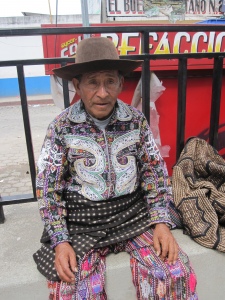 No, he is not backward or nostalgically old-fashioned trying to hang on to some rural dream in the face of inevitable progress and modernity. For Juan, it is a matter of personal experience. His oldest son was the only one to be educated beyond primary school. He even finished the Perito Contandor, a secondary school accountancy track that is one of the three most commonly offered in Guatemala, along with teaching and secretarial. “Study, study, study and years later still no jobs for him here. Waste of time!' Juan exclaims. “What are the solutions?” I asked. Swiping his hand at a fly and scrunching his face from the hot mid-day sun he replies: “there is no fix. There are too many people and not enough ways to provide jobs. The education is bad.” Juan strikes at the core of one of the key issues stopping rural Guatemalan children from going to school, and he should know as a once indigenous Mayor of Sololá. Even if the country was able to provide enough free schools, the Spanish-language education curriculum with eventual paths to work in an office, factory, or a shop, are geared towards urban jobs that are simply not available to everyone. “Like in many developing countries, the curriculum is designed within an urban setting…with no relation to the natural world or traditional knowledge, and the information is transmitted in a very Western form,” I was told by Steve Dudenhoefer, the founder of an indigenous run non-governmental organization (NGO), Ak'Tenamit 1. This is particularly problematic in a country where over 50 percent of the population work in agriculture, 69 percent live in rural areas and, according to UNICEF 2, over 40 percent are indigenous. It reinforces indigenous people's views that education is a ‘waste of time' when they see no further opportunity, so parents value children's short-term contribution to income and food security above long-term gains from education. In turn, this leads to high drop out rates. According to Save the Children 3, for example, although Guatemala has a 94 percent primary school enrollment rate—making it seem well under way to meeting the second United Nations 4 (UN) Millennium Development Goal 5 (MDG) of universal access to primary education by 2015—only 52 percent of children actually finish primary school, with urban completion currently being double the rural rate. 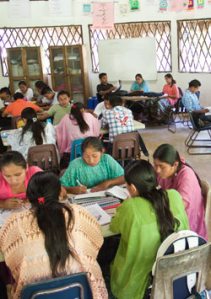 Ak'Tenamit is one organisation tackling this head on. Its founders recognised early that the country's education system was de-linked from the potential job market and over the years have developed their own methodology providing rurally-appropriate vocational training for indigenous boys and girls from rural areas to become future leaders in their communities and generators of their own wealth. The curriculum is implemented in their boarding school that serves as an academy and a practical training village. Set in a remote location on the Rio Dulce in the northwestern department of Izaba 6l, it houses an on-site restaurant and handicraft shop where students from hundreds of different rural communities receive some of their 3,000 hours of practical training in leadership, sustainable tourism, and community well-being, instead of training as accountants or secretaries. In the classroom, pupils learn about consensus building through group work, so they are empowered to engage with various levels of community and government to achieve agreement on practical action. Students also learn about, preserve and identify with their Maya language and culture, something that has been actively suppressed throughout much of Guatemalan history. ‘We are looking into the academic schedule to correspond to the Mayan calendar. It presents many challenges, but is incredibly innovative,” adds Jesse Schauben, a technical adviser at the NGO. Despite overwhelming evidence that the fastest route out of poverty in developing countries is female education, according to UNICEF, 95 percent of rural indigenous Guatemalan girls never finish primary school, completing on average just 1.2 years of education because of attitudes like Juan's. Local Maya Spiritual Guides and inspiring indigenous female role models, like Ak'Tenamit's Q'eqchi Director Lola Cobnal, work to overcome cultural barriers to girls' education by helping villagers truly reflect upon why it is important. As a consequence, today 39 percent of the school's graduates are indigenous young women, up a staggering 400 percent since 2001. 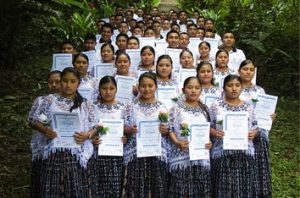 In other words, Ak'Tenamit gets results 7. Every single one of its 2009 graduates are now employed, 40 percent in their own villages. And, when they return, they are active role models who restore faith in education of whole communities. Yet, according to Steve, much political resistance to wide implementation of their model lies in the fact that “a small group of families still call the shots in Guatemala… they built their wealth up on very poor illiterate people and most still think that to stay on top many others have to stay on the bottom. They are OK with [people] learning to be better employees and generate economic activity, but they are not balled by the idea of them being able to decide what they want, being involved politically, becoming lawyers and doctors. They see that as a tremendous threat.” With this in mind, unlike many other NGOs, Ak'Tenamit does not shy away from political engagement. They lobby and lobby hard and are making tremendous in-roads. Albeit not yet widely implemented, their curriculum is one of few to be nationally accredited and they are the only indigenous-run NGO that receives funding from the Ministry of Education 8. The sky greys over and droplets of cold rain begin hitting the hot earth. As the characteristic rainy-season afternoon steamy fog begins to cloud up around the landscape I thank Juan for his time. As we say our goodbyes, I cannot help but be hopeful that in twenty years time, when wrinkles of wisdom begin to appear on my face too, I could return and have an entirely different conversation with his son. One filled with stories of rural indigenous communities standing on their own two feet through young inspirational leaders who have completed Ak'Tenamit-style rurally and culturally appropriate, and politically and socially empowering, education that he wants for all of his forty-five, maybe fifty, grandchildren, especially his girls. What do you think about the state of education in your country? Share your thoughts in the comments below. Like the article? Sign up at the top of this page to receive future entries directly to your inbox (make sure you click on the confirmation link that will be sent to you by WordPress). Notes: *Ak'Tenamit's photos from the NGO website ** You can find more stories from Ak'Tenamit including about the murder of one of their aspiring female indigenous leaders and the effect this has had on the organisation a July 2011 issue of lobal South Development Magazine 9. |
Links:
|
