|
Development Roast https://inesad.edu.bo/developmentroast/2011/10/book-roast-catching-fire-how-cooking-made-us-human/ |
Book Roast: “Catching Fire: How Cooking Made us Human” Meat made us smarter! At least that is what the mainstream explanation has been for the development of larger brains in humans and our subsequent distancing from other earthly life-forms and eventual domination over our planet. This is posited to have happened because through eating meat humans were able to consume a lot more calories than the traditional raw plant-based diets of early gathering societies. This, in turn, allowed for our stomachs to shrink as ‘we didn't need a giant vegetable processor anymore 1' (a sort of evolutionary, natural and slow equivalent of today's stomach stapling) that allowed for more energy to be channelled to building other organs such as the brain. The brain, incidentally, uses an incredible 20 times the amount of energy as typical muscle mass. Real food for thought for those trying to diet, but I digress. Arguably, meat eating also meant that less time could be spent gathering and more time thinking up new and crafty ways to catch pray such as sharpening spears and rock-launching devices. Increasing presence of meat in the human diet from roughly 1.5 million years ago 2is, thus, said to have set in motion the final stage of human evolution to bigger-brained, smarter creatures. Meat made us smarter! At least that is what the mainstream explanation has been for the development of larger brains in humans and our subsequent distancing from other earthly life-forms and eventual domination over our planet. This is posited to have happened because through eating meat humans were able to consume a lot more calories than the traditional raw plant-based diets of early gathering societies. This, in turn, allowed for our stomachs to shrink as ‘we didn't need a giant vegetable processor anymore 1' (a sort of evolutionary, natural and slow equivalent of today's stomach stapling) that allowed for more energy to be channelled to building other organs such as the brain. The brain, incidentally, uses an incredible 20 times the amount of energy as typical muscle mass. Real food for thought for those trying to diet, but I digress. Arguably, meat eating also meant that less time could be spent gathering and more time thinking up new and crafty ways to catch pray such as sharpening spears and rock-launching devices. Increasing presence of meat in the human diet from roughly 1.5 million years ago 2is, thus, said to have set in motion the final stage of human evolution to bigger-brained, smarter creatures.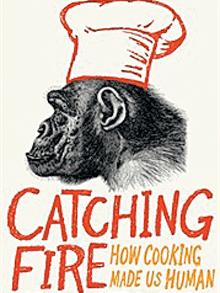 evolved to consume the flesh of others, yet that has not led to our being able to hold a Doctor Doolittle like intelligent conversation with a lion or a hyena. Richard Wrangham, in his book “Catching Fire: How Cooking Made Us Human”, posits that there is more to the human evolutionary tale than that. ‘We are more cooks than we are carnivores', he explains in this well-argued, evidence-based work that, despite covering some heavy ‘technical' ground in nutrition, biology and evolutionary anthropology, is wonderfully accessible. According to Richard, most of what we know about caloric and nutritional composition of different foods and our ability to ingest and digest them is, at best, flawed. This is because one of the fundamental effects of cooking food (plant or animal) is that it vastly improves its digestibiliy and reduces the burden on our stomachs. At the same time, processing of foods relieves the digestion process by cutting it up, which increases the digestible surface area of food and cooking further helps by causing starch to gelatinize, protein to denature and all types of foods to soften, making energy extraction much easier. Eating a pound of fresh tomatoes, therefore, is much less calorific than eating the same amount of them in an Italian salse al pamodoro. Our ability to extract more vital energy from our food was made possible by the human, perhaps accidental, taming of fire. Yet this was not fire's only contribution. Using ample evidence from archeology and evolutionary anthropology Wrangham highlights the cultural adaptations that had to occur if fire was to be used continuously. And used continuously it had to be for it provided defense against larger predators and a source of light and warmth. As a result, evolutionary pressure would have favoured calm, sociable individuals since huddling around a fire with an irascible firecracker of a neighbor or mate would not have made for amicable relations. Cooking also settled humans into mating pairs or groups that ensured protection of family meals and further, almost entirely universally, contributed to the division of labour whereby it had become the woman's role to provide cooked meals. The book finishes off with a call to arms for a long overdue update to the current food nutritional labelling system, which misleads consumers by allowing them to think they will get the same calorie and micronutrient levels from cooked or processed food as they would from the same food in its raw state. Wrangham challenges researchers to invest in figuring out a more accurate way to classify foods by the energy that the human body is able to extract based on the way it has been processed and prepared. He sites numerous experimental examples to state his case. For instance, in one preliminary experiment, Japanese women whose diets were softer than others had larger waists than the control group, whilst a natural experiment of raw-foodists (people who choose to eat foods only in their natural form with minimal processing) who appear to consume the required 2,000-2,500 calories per day in their diets, are in fact universally incredibly slender to the extent that normal reproductive functioning of women and sexual appetite of men is disturbed. If correct, and there is still controversy on the issue 4, Wrangham's findings have serious implications for problems of food insecurity, malnutrition, overnutrition and general human development in rich and poor nations alike. Moreover, Catching Fire has been called ‘that rare thing – an exhilarating science book 5‘ and the audio version of only 6 hours and 45 minutes is a fascinating listen with many Eurika moments for anyone unfamiliar with the central thesis. Meanwhile, the print version of wide-spaced 207 pages would make a great, concise weekend read. It should appeal not only to students, academics, and health and nutrition practitioners, but anyone interested in their own and their family nutrition. What part do you think cooking played in the social and cultural evolution of humans ? Share your thoughts in the comments below. Ioulia Fenton leads the food and agriculture research stream at the Center for Economic and Environmental Modeling and Analysis (CEEMA) at INESAD. Like the article? Be sure to sign up at the top of this page to receive future entries directly to your inbox (make sure you click on the confirmation link that will be sent to you by WordPress). |
Links:
|
