|
Development Roast https://inesad.edu.bo/developmentroast/2016/06/does-education-pay-in-bolivia/ |
Does Education Pay in Bolivia?  By: Lykke E. Andersen* By: Lykke E. Andersen*Returns to education in Bolivia have been dropping steadily over the last 15 years, to the point that some researchers have argued that education no longer pays[i] 1. Nevertheless, a record number of young people are in school or university. Are they all wasting their time? In this blog we will explore what has happened to the returns to education in Bolivia over the last 15 years, using standard household surveys (as well as the students in my Microeconometrics II course at UPB). After running several hundred Mincer earnings regressions of many different specifications, it is beyond dispute that returns to education have dropped dramatically between 1999 and 2014 (see Figure 1). In 1999, one additional year of education implied about 11% higher hourly earnings, but this benefit of additional education had dropped to just 4.3% by 2014. This is really shocking, and if the trend continues, education would indeed be worthless when the kids in primary school now finish their education. Figure 1: Average returns to education in Bolivia, 1999-2014 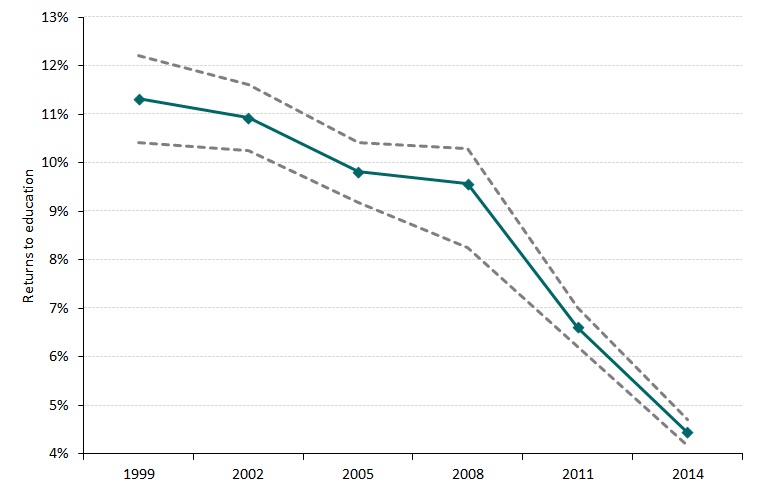 While very low, the returns to education are not yet zero. Not at the national level, and not for any significant sub-group that I could identify. In 2014, the group with the lowest returns to education were workers in the transport sector, followed by workers in the hotel and restaurant business. The ones with the highest returns to education were rural workers and workers in the department of Potosí. Everybody else earned just about average returns to education (see Figure 2). Even the highest returns in 2014, however, are very low by historical and international standards. Figure 2: Average returns to education in Bolivia, by sub-group, 2014  Figure 3 shows the changes in the returns to education in more detail, by years of education. In 1999 returns to education were approximately linear, with each extra year of education adding about 11% to hourly labor earnings[ii] 2. By 2014, however, returns had decreased substantially at all levels, except at the very lowest levels of education. Indeed, it now seems that all the years of primary school and secondary school add very little to labor earnings per hour. You would need 16 years of education to earn significantly more than a person with 1 year of education. By 2014, the three years after high school (13, 14 and 15 years of education) earned only a fifths of the returns that they did in 1999. The benefits of a complete university education (bachelor, master or Ph.D.) in 2014 was only a third of what it was in 1999 (see Figure 3). Figure 3: Returns to education in Bolivia, by education level, 1999 and 2014  I hate to admit it, but Werner Hernani is disturbingly close to being right. While technically, the returns to education are still significantly above zero, about two thirds of the 20-25 year olds in Bolivia currently have less than 13 years of education, and with that, they barely earn more than people with one year of education. This is a huge problem. While the changes in the returns to education have brought about a significant reduction in inequality in Bolivia, no country can be competitive in the global economy with an uneducated labor force, so the current situation is clearly not sustainable. The reasons for the current dismal situation are multiple and difficult to disentangle. One important factor is changes in the supply and demand of skilled labor. With the impressive increases in education levels in the country, the supply of skilled labor has increased, so it is natural that its price should decrease. At the same time, and due to the construction boom caused by the Dutch Disease caused by the boom in the prices of our main export products, there has been an increase in demand for unskilled labor (construction workers), which has put an upward pressure on the price of non-skilled labor. A different issue, however, is the quality of education. Right now, it seems that the education that the vast majority of school children in Bolivia receive simply does not help them improve their employment prospects. Bolivia has not participated in any of the international education quality surveys since 2002 (when results were frankly disappointing), but the regression results reported above suggest that our education system does little to improve local prospects, and probably does even less to help them compete internationally. Conclusion: The situation is much worse than I thought. Returns to education in Bolivia are technically still positive, but alarmingly close to zero. If this situation is maintained over a prolonged period of time, it will severely harm the long run growth prospects of the country. _____ [i] 3 Specifically, Werner Hernani from Fundación ARU, with whom I have made a bet that returns to education are still positive, while he claims they are 0. This post is my official argument, which is to be judged by Professor Miguel Urquiola of Columbia University -- Bolivia's foremost expert on education -- and compared with Werner's reply, to determine who is going to organize a barbecue party in October. [ii] 4 Linear returns to education means that the percentage increase in earnings is the same for each additional year of education. However, the same percentage increase implies exponential increases in the absolute level of earnings, which is why the curve with linear returns to education looks exponential. * Lykke E. Andersen is a Senior Researcher at INESAD. She greatly appreciates feedback on this post either in the comments below or directly to: landersen@inesad.edu.bo 5. The views expressed in this article are those of the authors and do not necessarily reflect the views of Fundación INESAD. |
Links:
|
