Development Roast Giving international development a proper roasting
 It is practically impossible to look into any part of international development without coming across “livelihood diversification”. It is a process whereby families in poor countries move away from relying on just one livelihood strategy to many different ones.
This is widely accepted to apply to the people of Asia, Africa and Latin America alike. The implication being that helping people diversify their livelihoods would be beneficial to development and poverty reduction, especially for those who cannot diversify themselves.
Is this broad assumption really that useful though? In other words, is livelihood diversification all there is or is something else also going on? Lets take a look at Guatemala.
As the name suggests, the term “livelihood diversification” refers to the fact that people employ different strategies in order to meet their financial and other needs. None do so more than poor rural dwellers of developing nations. Over the last few decades this has meant that families that had previously engaged mainly in subsistence agriculture have ‘diversified’ their ‘income portfolios’ (to stick to the jargon) and now are engaged in numerous different activities across different areas, both rural and urban. These include:
“both on- and off-farm activities which are undertaken to generate income additional to that from the main household agricultural activities, via the production of other agricultural and non-agricultural goods and services, the sale of waged labour, or self-employment in small firms, and other strategies undertaken to spread risk”.
Sometimes this occurs because people see opportunities to make more money in other jobs and in other settings, or to manage risks – what we could call the pull factors of diversification. In Guatemala, however, most are pushed into diversification because they struggle to carve out a sufficient living in agriculture, as one Maya lady explained:
“Right now I have a thousand occupations and work in many different places, we do what we can to get food”.
Depending on educational levels, these occupations include any combination of: agricultural day labour, making and selling traditional clothes and jewellery, logging, construction work, running small refreshment stalls, pedagogy and domestic work.
But this is not the only thing that seems to be occurring. Take the regional market that springs to life every tuesday and friday in the town of Sololá, the capital of a municipality and a department of the same name in the Western Highlands of Guatemala. In the early 1990s, a Japanese Anthropologist, Tadayoshi Murakami, had conducted a painstakingly detailed study of the country’s regional and local markets. He documented Sololá and other markets to be dominated by farmers working hard to sell their own produce. The farmers would travel to a different large market every single day, covering hundreds of miles and enduring up to five or six hours of daily travel with their goods in tow, in their struggle for a living. Now, however, things are very different.
In a couple of decades, Sololá market has been transformed and it is now overwhelmingly dominated by intermediary traders. Wholesalers tend to buy produce from farmers either at the time of harvest or agree on a lower price per acre of land beforehand and harvest it themselves. The latter option tends to be taken up by the poorest farmers and widows who cannot afford to employ labour to harvest crops. The main wholesalers then sell to other wholesalers for distribution around the country and/or to intermediaries in regional and local markets who then sell to the public. In the end, any given product can exchange hands four or five times before it reaches the consumer.
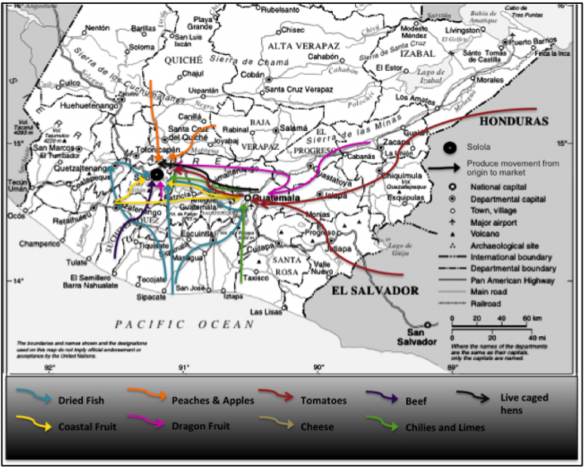
When you speak to the intermediaries, it becomes clear that agriculture simply stopped being a viable income generating strategy for them and their families, which is why they entered intermediary trading. There are several reasons for this and most constitute the push factors of agricultural production, such as: vastly unequal land distribution whereby 0.2% of powerful elites control 70% of arable land, confounded by the fact that many rural people have upward of eight children (some as many as 15 or 16), so inter-generational inheritance in reduced annually; most people moved from organic and traditional methods of cultivation to that of using synthetic fertilisers and pesticides, which are increasingly expensive to buy and have the negative effect of stripping the land of its productivity; the fact that Guatemala is subject to severe weather events such as hurricanes that cause widespread damages to crops; and so on.
But can the rise of the intermediary trader really be called livelihood diversification? It seems to me that, in fact, what we are observing is ‘specialisation’: some people specialise in production of agricultural goods, whilst others specialise in the trading of produce. Seen this way, it becomes clear that it is rather erroneous to assume that all poor people ‘diversify’ their incomes and increasingly rely on a large combination of different ‘occupations’. Like most poor, rural, farming Guatemaltecos, intermediary traders have certainly sought out other income streams as a result of agricultural push factors, but rather than ‘diversifying’ per se, they have, instead, put their efforts into ‘specailising’ in trading. In this sense, they are the ‘specialisation’ exception that proves the ‘need for diversification’ rule.
In this case, interventions that aim to help families ‘diversify’ their incomes further to manage risk could have a negative impact on the income generating potential of those that have found their special niche, as is the case with Guatemala’s intermediary traders. The take away here is that although observing general trends is useful, caution should be taken when using accepted wisdoms to inform policy and practice. Instead, local-level research can illuminate local differences and realities and, therefore, better inform initiatives to ensure they actually help the intended beneficiaries.
Do you know of real-life development examples that challenge accepted theoretical wisdoms? Leave a reply below.
Ioulia Fenton leads the food and agriculture research stream at the Center for Economic and Environmental Modeling and Analysis (CEEMA) at INESAD.
Like the article? Be sure to sign up at the top of this page to receive future entries directly to your inbox (make sure you click on the confirmation link that will be sent to you by WordPress).