Development Roast Giving international development a proper roasting

In 1957 the remains of a civilization from 3,000 years ago were discovered in El Beni, a lowland region in the northeast of Bolivia (see map below). This civilization was found to have a highly productive agricultural system which involved the construction of camellones (ridges). These were elevated fields, built to be above the height of the floodwaters, surrounded by channels. This produced a method of irrigation that protected crops from flooding whilst increasing the fertility of the soil. In the wet season, the rainwater collected in the channels, preventing the crops from being washed away. The water could then be stored and used to water crops in times of drought. This system was designed specifically for the ecosystem of the region which is particularly prone to flooding.

The concept, pictured below, is beautifully simple yet has many advantages besides protecting crops during the rainy season. For starters, a natural fertilizer can be produced by planting an aquatic plant called tarope, a type of herb native to South America, in the channels, which acts as a fertilizer when spread on the soil. Incidentally, tarope also purifies the water which is particularly useful because the channels can be used to farm fish. The excrement from the fish also help to increases the fertilizing power of the water. Also, because the water is stored rather than being left to drain into the Amazon, the nutrients which have leached into the water from the soil are not lost but can be used to re-fertilize the soil. So growing fields do not become exhausted every few years which would otherwise lead farmers to cut down more forest for farmland.
One man, Oscar Saavedra Arteaga, had studied sustainable development and the management of natural resources for many years, and he realized the potential of the system of camellones to increase food production and deal with the problem of flooding. He was one of the founders of the Kenneth Lee Foundation for sustainable development, and of the NGO ‘Amazonia Sostenible’. Through these two organizations, for many years Oscar has led research into adapting camellones for modern-day use. Together with the international non-governmental organization (NGO) Oxfam, he organized the construction of some trial camellones in 2007 in El Beni, one of the poorest regions of the Bolivian Amazon. The following year saw the worst floods in 50 years, causing US$200 million of damage and affecting around a quarter of the population. The camellones were the only farming structures that survived, prompting many villagers to overcome their initial skepticism and start taking an interest in the project.
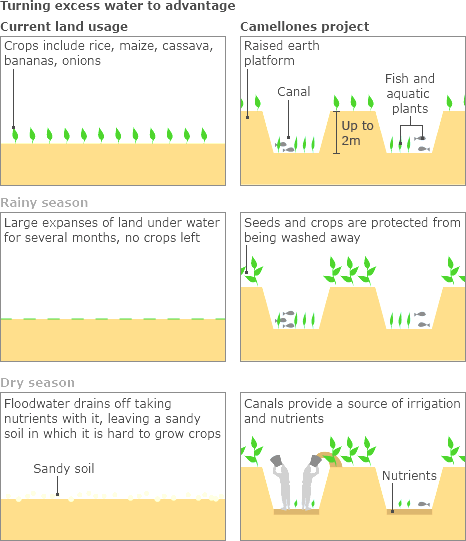
Now, around 400 families are involved in the project in five different locations. The initial results look promising. There are signs of increased productivity relative to the current modern methods in which a small area is farmed intensively for a few years until the soil is infertile. To create new farmland, forest must be cleared. Flooding can be catastrophic as it destroys crops and washes away vital nutrients from the soil. However, the philosophy of camellones is that excess water, managed effectively, is a beneficial resource and not a disaster.
So camellones are another example of how ancient knowledge can supersede modern techniques. Other projects looking to apply ancient technologies to modern day agricultural and food security programs can be found in other countries, like the similar system of aguadas found in the Mexican Yucatan currently being reconstructed by Anthropologist Betty Faust and her team, or the cleverly designed buildings for collecting rainwater in India’s Rajasthan Desert.
Both the Bolivian camellones and Maya aguadas systems are sustainable as there is no need for expensive machinery or chemicals, they do less environmental damage than the conventional technique of intensive farming and forest clearance, and they could help vulnerable communities to cope with the growing frequency and severity of floods and droughts caused by climate change.
To find out more about the man behind this pioneering work, read our interview with Oscar Saavedra tomorrow.
Do you know of any other ancient agricultural techniques which are used today? Please leave a reply below.
Tracey Li is a Research and Communications Intern with INESAD.
Like this article? Sign up at the top of this page for email updates.
For your reference:
Painter, J, BBC News 18 August 2009, Bolivians look to ancient farming. <http://news.bbc.co.uk/2/hi/americas/8187866.stm>
New Agriculturalist, November 2009, Reviving an ancient irrigation system in Bolivia. <http://www.new-ag.info/en/focus/focusItem.php?a=1015>
Noticias de Antropología y Arqueología: Especial Educación 2001, Moxos, el país del agua. <http://www.naya.org.ar/educacion/htm/articulos/ceam_intro%20manual.htm>
Oxfam, Changing lives in Bolivia. <http://www.oxfam.org.uk/what-we-do/content/changing-lives-in-bolivia>
Oxfam International, Adapting to climate change in Bolivia: reviving an ancient farming system. <http://www.oxfam.org/en/campaigns/climatechange/adapting-climate-change-bolivia>