 Development Roast Giving international development a proper roasting
 One of the primary lessons in Economics 101 is that of the rules of supply and demand in a market economy and their relationship to price. The basics being that the price of a product will adjust depending on the level of demand and level of supply in any given market and will eventually settle on an equilibrium when supply balances with demand.
Now we don’t need to go into all the details, as, for the sake of argument, we are interested in only one theoretical law governing this relationship. It states that should the market for a particular good get over-saturated with supply, then the price of this good will keep going down until a point where producers will stop making it or scale down their operations as they will no longer be as profitable.

Are you still with me? Don’t worry, there is a simpler way to see it. In more human terms, the theory goes something like this:
Imagine that I invent a new amazing solar powered car. It never needs charging from an electricity supply. Instead, it creates all of its own energy constantly from sunlight. It produces no waste, except for vapour, works great in both sunny and cloudy conditions and matches the speed and comfort of the leading petrol guzzler on the road. Pretty exciting, isn’t it?
At first, the market seems small and I sell only a few thousand cars, but once the word spreads, however, the cars already produced rapidly sell out with customers telling us they want hundreds of thousands more of the nifty little sun converters. So I put my minions to work and produce more and more of them.
A few years later my competitors catch on to the technology and begin producing similar cars cheaper in their hundreds of thousands and all of a sudden the price I could get for my vehicle falls considerably. In order to stay profitable, I and all other manufacturers now have two choices, either expand operations (either through growth or consolidation with other companies) to be able to buy my materials cheaper or reduce my operations to be more efficient, which unfortunately means firing some people, changing to cheaper suppliers in different countries and so on. And if that does not work, inevitably, many suppliers will go out of business. The result would be less cars until an equilibrium is reached where supply meets demand at a point where I can draw a good enough profit to continue, whilst my customers get an affordable car within their financial reach.
As elegant as this theory is, however, it does not represent reality in many cases. One sector that escapes this graceful logic is agriculture.
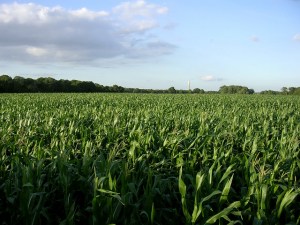
Take the example that Michael Pollan’s uses in the Ominvore’s Dilemma: that of the corn farmer in the United States. American agricultural policies underwent serious changes in the 1970s. Long story short, the effect was such that farmers were now encouraged to produce as much corn as possible and sell it at any market price. If that price fell below a pre-set minimum (what is called a price floor), the government would pay the farmer the difference in cash to make up for the low price and guarantee him or her a living.
Great! So, what’s wrong with that? Well, the result was too much corn in the market as farmers rushed to produce as much of it as possible and, as happened with my hypothetical solar cars, the prices kept falling. Meanwhile, almost all subsequent changes to the laws governing farm subsidises in the United States had lowered the minimum price that the farmer would be entitled to (the floor), significantly impacting how much income a farmer could gain.
If the assumed rational economic behaviour of the farmer indeed followed normal laws of supply and demand, then the crazy low prices that each farmer could get for a bushel of corn should have meant that many growers should have reduced or stopped their production of corn. However, as Pollan writes, the corn just kept on coming and in 2005 farmers were selling corn at $1 a bushel less than it cost them to grow it.
So what on earth is going on? Why are these farmers not behaving in an economically rational way? One convincing answer to this conundrum comes from a corn farmer called George Naylor, who explains that what it comes down to is that you can’t fire your land or give up your land for cheaper plots in another country to make yourself more efficient and reap higher rewards, so:
“Farmers facing lower prices have only one option if they want to be able to maintain their standard of living, pay their bills, and service their debt, and that is to produce more corn.”
Michale Pollan continues:
“A farm family needs a certain amount of cash flow every year to support itself, and if the price of corn falls, the only way to stay even is to sell more corn…. farmers desperate to boost yield end up degrading their land, plowing and planting marginal land, applying more nitrogen – anything to squeeze a few more bushels from the soil. Yet the more bushels each farmer produces, the lower the prices go, giving another turn to the perverse spiral of overproduction.”
And if the farmer does eventually go broke and has to sell his land, this does not mean that there will be less supply of corn to rebalance the system, as would happen with my car enterprise going out of business. As George Naylor goes on to say, the land would just get right back into the agricultural circulation:
“The free market has never worked in agriculture and it never will. The economics of a family farm are very different than a firm’s: When prices fall, the firm can lay off people, idle factories, and maker fewer widgets. Eventually the market finds a new balance between supply and demand. But the demand for food isn’t elastic; people don’t eat more just because food is cheap. And laying off farmers doesn’t help to reduce supply. You can fire me, but you can’t fire my land, because some other farmer who needs more cash flow or thinks he’s more efficient than I am will come in and farm it. Even if I go out of business, this land will keep producing corn.”
The result is a growing mountain of corn that someone, somewhere has to consume (whether as food or, increasingly, as fuel); consolidation of many small farms into huge industrial monocultures; and a slippery slope of increasingly impoverished, heavily indebted farmers increasingly unable to earn a decent living. And this year, American farmers were predicted to plant more corn than in any year since the 1980s, although harvests are affected by the current drought.

Yet, it is not only economic considerations that govern farmer decisions. Culture can play an important part too. On January 1st 1994 Mexico signed the North American Free Trade Agreement (NAFTA), which removed some barriers to trade between it and the United States and Canada. This resulted in a flood of imported cheap U.S. corn into the country (one way to get rid of those surpluses). The U.S. corn underpriced domestically grown varieties and, as a result, threatened to and did push many Mexican farmers out of the corn business, which is what lower prices would do under the laws of supply and demand.
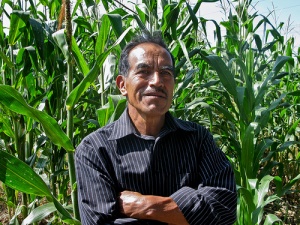
Yet, many farmers defied market logic and continued to farm native varieties, at a relative loss to themselves, despite the fact that the imported corn was much cheaper to buy. This was largely because the Mesoamerican cultures are built on the belief that the Maya people were made out of corn by the Gods. Corn is how they perceive their cultural genetic make up and corn tortillas are eaten with every meal. It is a source of pride, independence and tradition.
This cultural heritage was too important to many farming communities and agriculture was not just a job, but a way of life and the centre of their identity. They could not accept cheap imitations or give up their way of life by abnegating their right to grow corn to market imperatives.
What many Mexican farmers perceived as an attack on their rights to produce culturally appropriate foods for themselves turned into a global movement to establish Food Sovereignty, that is driven by La Via Campensina—a network comprising of 150 local and national organizations in 70 countries from Africa, Asia, Europe and the Americas, representing 200 million farmers:
“Food sovereignty is the right of peoples to healthy and culturally appropriate food produced through sustainable methods and their right to define their own food and agriculture systems. It develops a model of small scale sustainable production benefiting communities and their environment. It puts the aspirations, needs and livelihoods of those who produce, distribute and consume food at the heart of food systems and policies rather than the demands of markets and corporations.”
The two examples illustrate that we cannot apply a one size fits all model of free market economics to the real world. Each sector is different. National and multinational policies based on theoretical abstractions can and do create perverse incentives that affect our systems of production negatively. And when it comes to people’s livelihoods, the cultural traditional man that cares about his independence can prevail over the rational economic man that is happy to cede control of his means of producing food to global capitalist imperatives.
So, when we decide on future agricultural and trade policies to benefit the majority, produce just enough culturally appropriate foods and help alleviate poverty perhaps we need to dethrone the free market economics that has, for four decades, shaped the world we live in.
Ioulia Fenton leads the food and environmental stream at the Center of Economic and Environmental Modeling and Analysis (CEEMA) at INESAD.
Do you know of other real-life examples that challenge mainstream economic theory? Share your thoughts in the comments below.
Like the article? Be sure to sign up at the top of this page to receive future entries directly to your inbox (make sure you click on the confirmation link that will be sent to you by WordPress).





Free market economics are nice if you are already rich and wealthy as an individual/community/country.
If you are impoverished,hungry and malnourished you face virtually insurmountable problems in doing the right thing with your choices being dictated to by the “market”.
The market being this construct of a place where demand and supply meets.
The truth is that capital determines will be supplied in the market the demand being driven by purchasers who again are people with capital.
What happens to the impoverished millions who need basic nutrition but do not dent the markets with their presence due to an absence of capital as producers or consumers?
What is right for all humans on earth to live with their basic needs being met can certainly never be left to market forces.The market only seeks profit and profit by itself is not adequate for an inclusiveness of all.
Agree with you entirely. Thanks for reading
I have farmed in Minnesota USA since the mid-90s and experienced the dynamics Ioulia describes. Supply-and-demand does work in farming and farmers would “fire” their land from producing corn if corn was $1 below production, unless they could convert that raw material to something of higher value. Farmers, me included, did not fire our land, because the policy-market signal (counter-cyclical payments) ensured I would recieve at least enough to survive another year. Governments are scared to leave agriculture up to supply-and-demand forces because of the importance of providing a market signal so farmers will grow food regardless, because hungry people vote out politicians, and very hungry people try to overthrow governments.
After years of corn surplus, enough people knew that something could be done with it and the Minnesota Miracle was created to establish policy to convert the corn into starch-ethanol and protein-feeds. And besides of option of firing your land you could give it a different job than growing corn. It is economically rational to grow corn when the market price is $1 below the cost of producing it, only if another policy-market price will cover that. No one could grow corn for cash flow if the price was below production costs without a floor. Land, labor, inputs, risk are far too expensive for that.
Wow!! Ok, I am not much into the theories of economics and, while I like the thought of learning about agriculture, there is only so much time in a day (and I push that limit severely). However, this article is so well written that, after reading the first two paragraphs, I had to read on to the end. Ioulia has put a slant on this subject that I have never considered. To be honest I have always thought that the laws of supply and demand were logical enough to not need questioning. I hope to read many more articles from Ioulia and the rest of your team at INESAD!!!
Dear Steve,
Thank you so much for your wonderful comment. This makes the writing worthwhile and we look forward to many more comments from you.
Thanks for reading,
Ioulia
Thank you Ioulia for this refreshing take on Economics 101. Michael Pollan, George Naylor, Mexican corn farmer, La Via Campesina. I knew them from different worlds but you connected them seamlessly in one piece. Indeed we need new lenses in looking at the plight of farmers. Keep those ideas flowing! Cheers!
Dear Arnelo,
Many thanks for reading. Do you write at all? We would love to connect if you have a blog or other outlets.
Also, dont forget to follow us on twitter on @devroast and Facebook: http://www.facebook.com/pages/Development-Roast/505632876118317