Welfare Economics

Road blog No. 1: Murderous road signs

By: Lykke E. Andersen*

Academic research is rarely nauseating, and I did not expect to get sick to my stomach from a research project we have with Boston University called “Safeguarding Sustainable Development.” The project is simply trying to find out whether the social and environmental safeguards of the institutions that finance major infrastructure projects in Latin America (e.g. CAF, IDB, WB) help secure the successful implementation of the projects with minimal environmental harm and minimal harm to the people living in the affected areas. The project covers several countries, but at INESAD we just have to evaluate three Bolivian road projects.

Last week we visited the first of our road projects, which is the double-road between La Paz and Oruro (Bolivia’s Highway No. 1). Most people appreciate this new road because it makes travelling between La Paz and Oruro much quicker and safer. It also created lots of local jobs during construction, and local communities have generally been adequately consulted and well compensated for the direct adverse effects of the road construction project. Local people quickly figured out how to get from A to B using this new road (even if it means driving in the wrong lane in the wrong direction for a stretch), so for them the lack of, or highly confusing, road signs were not considered a big problem.

Read More »

Chasing a moving target: 100% coverage of water and sanitation in Bolivia by 2025

By: Lykke E. Andersen*

Last month I participated in a very interesting workshop on water and sanitation in rural Bolivia organized by the Ministry of Environment and Water. I learned from the engineers and sociologists there that things are never as simple as economists tend to think. But as the only economist present, I also tried to teach the engineers and sociologists that things are not as simple as they tend to think.

With the combined insights from engineers, sociologists and economists, I have reached the conclusion that 100% coverage is an elusive target for at least five different reasons:

First, the population growth rate in Bolivia is about 1.5% per year, which means that even if we reach 100% coverage by January 2025, by December the same year there will be almost 200,000 additional people who need water and sanitation.

Second, the population is not only constantly growing, but also constantly moving. More than half of all Bolivian municipalities are losing population due to internal migration (see Map 1 below), while a few dozen municipalities are receiving the vast majority of these migrants. The main receiving municipalities are: Santa Cruz de la Sierra (32,000 migrants per year), El Elto (20,000), Cochabamba (11,000), La Guardia (6,000), Warnes (6,000), Oruro (6,000), Sacaba (6,000), and Tarija (5,000) (1). Close to a million Bolivians will have moved from one municipality to another between now and 2025, and most of them will likely come from the disperse rural communities that the government is currently prioritizing for water and sanitation investments. The most extreme example in the map below is the municipality of Chayanta in the northern part of Potosí. In the five years before the 2012 population census, it lost 29% of its population to migration, despite having just reached 94% coverage of water.

Read More »

Death penalty versus castration: A thought experiment

By: Lykke E. Andersen*

Stories about sexual violence against girls and women are common in the Bolivian news, but recently the stories have escalated to such hideous levels that the Vice-President of Bolivia has announced a referendum on whether to re-institute life-in-prison and death penalty in Bolivia (1).

For example, last Sunday, one of the guards of the “Defence of Children and Adolescents” facility in La Paz was caught in fraganti sexually violation two under-age girls who had come to the facility because they had suffered abuse (1).

The day before, a step-father and step-grandfather were jailed in Cochabamba for sexually violating and killing a baby girl, who had not even turned two (2).

A couple of weeks before, the President of the Municipal Council of Tapacarí (Cochabamba) was physically and sexually assaulting one of the female members of the Council, and a friend of the woman was trying to stop the assault when the Mayor arrived. But instead of helping the two women, the Mayor exclaimed “Why haven’t you raped these horny whores yet? Rape them and throw them in the river.” (3)

Read More »

On Gender Equality in Education

By: Lykke E. Andersen*

According to The World Bank’s World Development Indicators, there are now more or less an equal number of boys and girls enrolled in primary and secondary school around the World. The worldwide Gender Parity Index has been going up steadily over the last several decades, reaching 99 girls for every 100 boys in 2014, and at this rate of change we would have reached parity last year. This is due to dramatic improvements in girls’ enrolment in Africa and Asia. In Latin America and the Caribbean, in contrast, there have been more girls enrolled than boys already since the early 1980s (see Figure 1).

Read More »

Where are the poor in Bolivia?

By: Lykke E. Andersen*

Two of the Sustainable Development Goals recently agreed by all the member states of United Nations are to reduce poverty and to reduce inequality, and for those goals to be realized, the incomes of the poorest 40% of the population have to increase. Designing policies to reduce poverty and inequality at the very least requires us to know where to find the target population. In this blog I will argue that they are probably not where you think they would be. Read More »

Energy = Modern Civilization²

By: Lykke E. Andersen*

The World’s most famous equation is undoubtedly Einstein’s E=mc2, and while it stipulates that the total amount of energy in the Universe is constant and cannot be created nor destroyed, only transformed, I will argue that the harnessing of energy for human purposes is what has made the exponential growth of our civilization possible. Read More »

Changing Wealth – Changing Health

Print

By: Lykke E. Andersen*

Bolivia has recently changed from a low income country to a lower-middle income country, and with that increase in incomes the disease burden has also changed. In 1990, Bolivia’s disease burden was dominated by infectious diseases and maternal health problems (pink group), which is typical of poor countries. By 2013, however, the blue group, which encompasses non-communicable diseases (such as cardiovascular diseases, cancer, diabetes and mental disorders) has become dominant, as it typically is in richer countries (see Figure 1). Read More »

Can you envision a sustainable world? Do you dare to dream today?

By Susana del Granado *

“A vision comes not from the intellect or the mind but from the heart, from the soul”

Donella Meadows

Today, June 5th , we celebrate World Environment Day and, as a celebration, the United Nations Environmental Program has launched a campaign and a contest about “sharing your dream[1]” to move people to imagine a sustainable future and to trigger discussion on the objectives for sustainable development[2].

A vision is a desirable future and, by definition, it is a positive image of what you want to see in the future. Donella Meadows, an environmental scientist and leading author of “The Limits to Growth”, while presenting at an ecological economics conference, inspired and requested her audience to envision a sustainable future. To develop that vision, she asked them to get comfortable, to close their eyes, to take a deep breath, and to dream:[3] Read More »

Father’s Day and teenage pregnancy in Bolivia

Lykke Andersen

By: Lykke E. Andersen*

Fertility rates have been going down all over the World much faster than most people realize. Fertility rates in Bolivia, for example, have come down from 6.5 babies per woman in 1971 to 3.2 in 2013, which is typical of developing countries (1).

This evolution made me suspect that the problem of high teenage pregnancy in Bolivia perhaps has already solved itself, and that I don’t really have to worry about becoming a grandmother anytime soon.

However, a quick look at the latest Bolivian population census (2012) indicates that teenage pregnancy is still very common. Seven percent of all 15 year olds already have a child, and this share increases to a whopping 49 percent for the 20 year olds, many of which already have 3 children (see Table 1).

Read More »

Incredible Internet Inequality

Lykke Andersen

By: Lykke E. Andersen & Fabián Soria*

According to the latest Bolivian Population Census (2012), only 9.6% of households have Internet access (either fixed or wireless). Considering that the Bolivian Constitution puts telecommunications (including Internet) on par with water, sanitation and electricity as a basic human right, this coverage is outrageously low.

The main reason for the low coverage is the high cost. Even after nationalizing the telecommunications sector (2008) and investing USD 300 million in our very own telecommunications satellite, Tupac Katari (2013), Internet services in Bolivia remain patchy, expensive and slow compared to other countries in the region. For most Bolivians, having Internet at home is simply unaffordable.

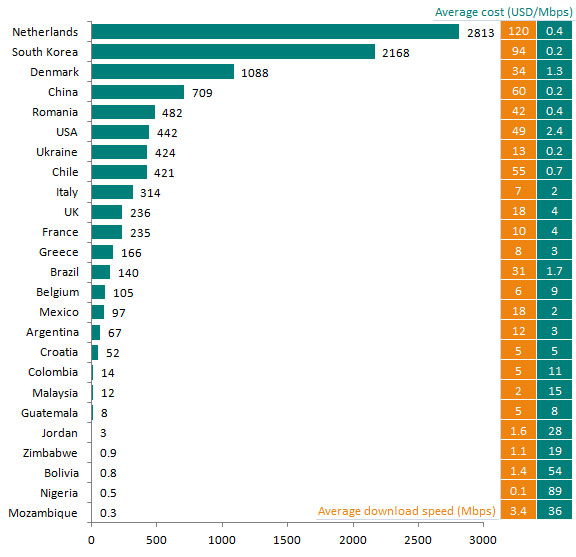
Figure 1 shows that, for an average person in Bolivia, one hour of work would buy less than 1 day of a lousy 1Mbps (Megabits per second) Internet connection, whereas the average person in “developed countries,” such as the Netherlands, South Korea, Denmark, and China could buy several years worth of such a service for just one hour of work.

Figure 1: Internet Purchasing Power (days of 1Mbps Internet service that can be bought for one hour of work), as well as average download speed and average cost per Mbps.

Internet1
Source: Authors’ elaboration based on a survey among Facebook friends (and friends’ friends) during February 2015 Notes: The calculations are rough and based on a very limited number of observations in each country (often just one). Effective download speed was measured by all participants using http://www.speedtest.net/. The average hourly salary is estimated from the Gross National Income per person. Most friends are located in main cities, which may not be representative of the whole country. In some places, free cable TV is included in the price.

Read More »

Follow

Get every new post delivered to your Inbox

Join other followers: