April 19, 2013Labor EconomicsComments Off on INESAD News: Economic Symposium a Success
With a record number of supporters, the fifth annual Economic Symposium, held in Cochabamba, Bolivia on April 18, 2013, led by INESAD, proved a giant success. The event was attended by almost 150 participants from across the academic, public and private spheres.
For the past three years, I have been studying the lives of long-term sickness benefits recipients in North East England, U.K. as part of my PhD research. In that time, government policy has increasingly distinguished between the ‘deserving’ and ‘undeserving’ in relation to sick and disabled people. Yet it is not only policy that makes that distinction.
In recent years, the media have taken a more vitriolic stance towards sick and disabled people, often branding them deeply offensive terms such as ‘scum’, ‘feckless’, and ‘work-shy’ (Garthwaite 2011). A comparable discourse is evident not only in political debates and the mass media, but also when considering public opinion. Polls show unsurprising support for welfare reform plans, signalling the public’s negative view towards benefits and people who receive them. For example, an IPSOS Mori poll carried out for the BBC published in October 2011 revealed that although a resounding 92 percent of British people wanted a benefits system providing a safety net for all, 63 percent doubted the U.K. benefits system works effectively, 72 percent wanted politicians to do more to cut the benefits bill, and 84 percent wanted to see stricter testing for sickness benefits. Read More »
Every year, March 8 is a date reserved for honoring the fairer sex around the world. To celebrate some of the best the world has to offer, Development Roast brings you 8 organizations that are making a difference to the lives of Bolivia’s women. Happy international women’s day!
FIMI & MADRE Building Political Participation:
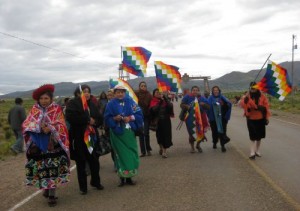
Bolivia’s Indigenous Female Parliamentarians. Photo Credit: MADRE
International Indigenous Women’s Forum (IIWF), which is best known by its Spanish name and acronym Foro Internacional de Mujeres Indígenas (FIMI), was founded in 2000. It is a network of indigenous women from all over the world that partners with another global women’s organization, MADRE, to increase the role of women in international decision making, improve women’s human rights, and build political participation of women in Bolivia. Read More »
This question has been asked many times before, and has featured in many of this month’s Development Roast articles. The first post of the month asked ‘How poor do poor people feel?‘ The answer was that some of them don’t feel as poor as other (richer) people expect them to feel. This was followed by a Monday Graphics piece entitled ‘Is there more to life than money?‘ (In summary, ‘yes’). Then came ‘Masking Poverty: Why Poor People Like to Appear Rich‘, exploring how poor people in China feel better if they appear richer than they are, which necessitates having sufficient money to purchase the appropriate clothes. So in this case, money does indeed make these people feel happier. The next post was entitled ‘The Conundrum of Identifying the Poor‘, a discussion about the difficulty of identifying those who are most in need of aid. The most satisfying method for the community turned out to be for themselves to decide who are the poorest amongst them, since it most accurately identifies those that feel the poorest, even if they are not necessarily the ones with the least money or possessions.
As shown in our post “Is there more to life than money? Mapping happiness of people and planet”, several attempts have been made to measure happiness and wellbeing globally. However, consensus proved elusive since different studies brought very diverse results. That is because happiness is a very hard thing to define – if it had a clear, objective definition, our lives would be a lot easier, wouldn’t they? Still, there are several working definitions, and most of them can be grouped in either of the following two categories. On one hand, there is a happiness that relates to one’s satisfaction with their lives. That often involves a feeling of having achieved one’s goals in life, having an option not to work in an extremely degrading job, having good relationships, etc. On the other hand, there is a more emotional happiness. That is much more momentary, it is the “state of mind of feeling good”. According to the latter definition, one’s happiness would be measured by how often, how intensely, and for how long one “feels good”.Read More »
What is the psychology of poverty? This question has been a contentious one in anthropology, particularly during the last half a century. In La Vida (1966), a study of poor Puerto Rican families, Oscar Lewis argued that poverty produces certain psychological traits and social behaviours that become enculturated. His ideas caused an uproar because they were widely interpreted to imply that so-called poor people are not capable of escaping poverty. Critics lamented that his book was being misappropriated by the U.S. Government to implement paternalistic, “blame the victim” policies among poor African-American communities that stripped them of their agency, treating them like hopeless cases that needed to be disciplined rather than assisted.
Since then, a plethora of research in poor communities around the world has overturned the idea of a global culture of poverty. Read More »
As a result, the topic of pro-poor development often sparks lengthy debates when raised, since without a specific definition of what poverty is and what it is not, people differ in their views of how to relieve people of this intangible concept. This is especially the case when supposedly very poor people actively choose their lifestyle over one that offers financial gains through entering the world markets, a phenomenon that is largely attributed to poor people’s assumption that certain financial improvements would threaten their community lifestyle, which in the end is what they prize above all else.Real poverty, rather than just being poor, can be defined in terms of food insecurity: if you cannot provide food for yourself and your family due to physical or circumstantial restrictions to sufficient finances or fertile land, then you are living in poverty. Read More »
Here’s a question for you: how do we know that all the aid given to Africa has had any effect? The tricky thing about trying to answer this question, and analyzing problems such as global poverty, is that the world cannot be treated as a laboratory experiment. We cannot create two identical Africas and give aid to one and not the other, keeping all the other variables such as political conditions, climate, and population, constant.
What happens in fields such as medicine, when we want to know whether a drug works or not? Suppose we’ve developed a new pill which, we think, prevents headaches. We find two chronic headache-sufferers who are identical in terms of gender, age, and general health, and X takes the pill every day but not Y. After a month it turns out that X no longer suffers headaches but Y does. What can we conclude? Well, nothing at all. Because we have no way of knowing what would have happened if X hadn’t taken the medicine – maybe his headaches would have disappeared anyway because he finally started wearing his glasses.
I used to think that giving aid was easy. You just find those in need and give them money, incentives or beneficial programs, right? It turns out that even the seemingly simple initial process of identifying the poor is not as easy as it sounds. Not only has a truly efficient method of identifying those living in poverty yet to be established, but there are discrepancies between community satisfaction with known methods and the method’s official success rate.
The main challenge that is faced by researchers and potential benefactors in developing countries when identifying poor people is a lack of reliable income data. Many of the poorest people work informally and/or inconsistently, with few or no verifiable income records. Considerable and creative efforts therefore need to be made to identify intended beneficiaries if aid money is not to be misdirected toward wealthier households.
To date, Proxy Means Tests (PMTs) have proved the most accurate method of identifying families living on USD$2 or less a day. Read More »
Poverty is more than an income measure or financial disadvantage. It is also a state of mind, a feeling of anxiety, and it forms the perception that society has of individuals, and even the perception these individuals have of themselves. It is because of this that people living in poverty face so many limitations, ones that go beyond the mere size of their wallet. They experience a lot more stress and social pressure. Those who consider poor people to be lazy treat them as if they were inferior, and, in turn, poor people try to mask their poverty in order to receive better treatment. Read More »
 Development Roast Giving international development a proper roasting
 With a record number of supporters, the fifth annual Economic Symposium, held in Cochabamba, Bolivia on April 18, 2013, led by INESAD, proved a giant success. The event was attended by almost 150 participants from across the academic, public and private spheres.
 By Dr. Kayleigh Garthwaite
 By Ioulia Fenton and Tracey Li.