July 4, 2012
Conservation, Consumerism
 “There is an expiry date on blaming your parents for steering you in the wrong direction; the moment you are old enough to take the wheel, responsibility lies with you”.
J.K. Rowling 2008 Harvard Commencement Speech (available as transcript and video)
Anyone interested in conservation or other environmental issues will undoubtedly put at least a considerable chunk of the responsibility for our current predicament onto our parents’ and grandparents’ generations. Although there may be some truth in that, if we are really honest with ourselves, few find it hard to live up to environmental principles today – we all enjoy the conveniences of the world we condemn. Read More »
May 31, 2012
Agriculture, Alternatives, Ancient Technology, Food, Indigenous Peoples, Solutions, Sustainability, Water
“More and more and higher-level technology” is heralded as the way that the human population will eventually get itself out of the global troubles it has wreaked. Under-researched genetically modified seeds to be sold to poor rural farmers in India; financially, socially and environmentally expensive Three Dams Project in China; and ethically dubious biofuel alternatives made in order to stem the toxic air pollution of the global transport industry. Each high-tech solution has its merits and its downfalls, of course, but do we always need to be looking forward or could we learn something from our ancestors? Read More »
May 17, 2012
Agriculture, Conservation, Diet, Ethics, Food, Infographics, Natural Resources, Solutions, Water
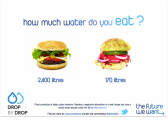 Meat production is thirsty business. Do you know much water do you eat? INESAD’s latest inforgraphic provides some real food for thought. Did you know, for example that a beef burger takes 2,400 litres of water to produce, compared to 170 litres for a vegetarian burger.
Find out more at www.unwater.org and www.waterfootprint.org.
Read More »
May 13, 2012
Conservation, Infographics, Natural Resources, Sustainability, Water
 Did you know that passing up just one beef burger saves the water equivalent of 40 low flow showers? INESAD’s latest infographic aims to encourage diet-based water conservation. Love it, live it, share it.
Find out more at www.unwater.org and www.waterfootprint.org.
Read More »
March 30, 2012
Agriculture, Diet, Food, Infographics, Water
 March 22nd saw this year’s World Water Day kick off a series of upcoming events organised by the UN and other organisations to highlight global water issues.
Luckily, there is lots of good news, like the fact that half of the internationally agreedMillennium Development Goal on safe drinking water and sanitation has been met ahead of schedule. According to a joint report by the World Health Organisation and UNICEF:
“Since 1990, more than 2 billion people have gained access to improved drinking water sources.” Read More »
March 21, 2012
Agriculture, Food, Food & Agriculture, Health, Obesity
 Corn, corn, corn; mountains of corn as far as the eye can see. The images of the piling up Iowa harvests were one of a number of poignant visuals brought forward by the 2007 documentary King Corn (available on Netflix). The fact is, US production of corn has been growing rapidly since the 1970s and this year American farmers will plant an unprecedented harvest – 94 million acres of corn crop. This is the largest since 1944 and will take up roughly a third of the country’s harvested cropland.
This expanse has been largely driven by a change in direction of US farm policy four decades ago. Previously, agricultural production was tightly controlled to ensure overproduction did not drive the prices that farmers could get for their harvests too low and helped ensure that available agricultural land was not overworked and the environment was not unduly harmed. Read More »
December 9, 2011
Agriculture, Book Roast, Food, Food & Agriculture, Policy, Politics
 In this 2010 book Robert Paarlberg takes a Q & A approach to a broad set of food and agriculture topics, covering aid and trade, obesity and famine, organic farming and genetically engineered (GE) organisms, and the food system’s effects on health and environment, among others. The work is a self-proclaimed attempt at “rebalancing some debates around food and farming” for “an aware audience of non-specialists.” And on the whole, its strength lies in its accessible style and the common myths it dispels: how buying local produce, for example, is not necessarily more environmentally friendly or the fact that global market food prices do not automatically increase local consumer costs.
For all its breadth, however, the book is beset by problems. Read More »
July 27, 2011
Agriculture, Food, Food & Agriculture, Girls & Women, Health
 As the Victoria Beckhams of this world have replaced the Marilyn Monroes on the centerfolds of magazines and advertisements selling everything from perfume to real estate, wide social effects have taken place in rich nations. Although size zeros are no heroes, adolescent girls and grown women the world over have succumb to chasing the promised good feel of the thinness ideal. At the extreme, this chase can lead to conditions diagnosed by mental health professionals as binge eating and disordered eating (which includes self-starvation, bingeing, purging and exercising obsessively), leading to more widely known conditions of anorexia (self starvation) and bulimia (regular self-induced cycles of binge-eating and vomiting), found to affect up to 5.7% and 7.3% of women in Western nations respectively (1). Both are addictive psychological attempts to take back control over inputs into the body and sometimes other aspects of life. And both are on the rise in less wealthy countries too as they transition into Western lifestyles brought to them through cultural and corporate marketing transmissions associated with the age of globalisation (2). Read More »
July 15, 2011
Agriculture, Food, Food & Agriculture, Health
 If the old parable is true and you are what you eat, does food affect who we are and what we think? I have previously written about the visible problems associated with poor diets in the world such as obesity, diabetes and food related cancers and the possible starting points for individual and public policy solutions. However, one notable health aspect generally missing from discourse on food policy is that of mental health problems associated with diet. These can include depression, with associated human cost of suicide, and health problems due to malnutrition associated with eating disorders. For example, according to the World Health Organisation “in low-income countries, depression represents almost as large a problem as does malaria (3.2% versus 4.0% of the total disease burden)” and every year 844,000 people commit suicide globally, a staggering 60% rise in the last 45 years. It is a pricey omission too since mental health issues are highly costly to: societies overall through their national health and medical systems; to the private sector through lost days of work; and to individuals through the suffering of depression or the silent, and often unreported and untreated, psychological and physical suffering associated with eating disorders. Mental health disorders cost the UK National Health Service, for instance, an estimated £77bn ($120bnUSD) annually and 77,000 people currently out of work due to mental health problems. Read More »
June 24, 2011
Agriculture, Culture, Food, Food & Agriculture, Indigenous Peoples
 Until recently, probably like for many of you, my imagination when it came to corn, aka maize, was limited to a bright yellow sunshine goodness, steamy and fresh on the cob soaked in butter and lightly salted, bursting with warm juices with every bite, the remnants of which I discover in my teeth hours after I am done. Or, perhaps, some ready-to-eat tinned sweet-corn kernels added to my jacket potato, tuna, chilli (sin)carne or simply adding a crunch and a juicy burst to my salad plate. In reality corn comes in a rainbow of colours and subtle gradient of tastes and despite one or two varieties being only an occasional dinner or snack companion for many of us in the West, corn or, as it is known in Spanish, maiz, has been the mainstay of the peoples of Central America and many other countries for centuries. Read More »
 Development Roast Giving international development a proper roasting