 Development Roast Giving international development a proper roasting
 According to the 2005 World Summit on Social Development, sustainability requires the reconciliation of the three elements of economic, social and environmental endurance. Up until not too long ago, companies externalized costs to society and the environment and took advantage of cheaper and more convenient labour in their restless pursuit of profit. However, activism and awareness campaigns by NGOs have encouraged consumers to demand more sustainable products and services. As a result, today, many companies proudly advertise their sustainable business practices. The ensuing policies of “corporate social responsibility” (CSR) are in part motivated by the long-term financial savings sustainable businesses can make; however, they are also a marketing strategy aimed at convincing people that their money is being invested in something that is good for people and the planet. Read More »
Live Research Bulletin: The opposite poles of environmental accounts of Canada and the United States

“I’m not in this race to slow the rise of the oceans or to heal the planet.” Republican Presidential Candidate Governor Mitt Romney, an interview on “Meet the Press”, September, 2012.
This month, Development Roast has published several posts offering insights into different principles and practices of green accounting. After our overview of European experience with environmental accounting, we now turn to North America. Excluding Mexico (which will be discussed next week in the Latin America update), the two remaining countries show us quite different experiences with greening the national accounts. While Canada has shown to be an example of comprehensive implementation, the United States suspended its national project for environmental accounting in 1995 and hasn’t made large attempts to develop these accounts since. Read More »
Powering the forest sector in Bolivia with renewable energy
 By: Miguel Rodríguez Tejerina
Despite half of Bolivia being covered by forest, the forest sector represents only 1-2% of GDP. According to Supreme Decree 26075 of 2001, more than 40 million hectares are destined by the State for sustainable forest use, but currently only about 9 million hectares are being sustainably managed for wood production, mostly by private companies (5 million hectares) and indigenous and peasant communities. The rest is either not being used, or being exploited in an illegal and haphazard manner.
Live Research Bulletin: Accounting for the Environment in Europe—Progress and Lessons.
Throughout November Development Roast is bringing you live research updates on an INESAD working paper currently in progress that is investigating national environmental accounting efforts around the world. Today, Carolynn Looks sums up the European experience.
A kilo of tomatoes in Spain typically costs around €1.99. This price includes the efforts of the farmer who grew the tomatoes, transportation costs, and the work of the retailer. What it does not include is the cost of emissions as these tomatoes make their way across Europe, or of water usage, deforestation and loss of biodiversity as monoculture plantations spread across Spain’s rural landscapes. Because of an increasing recognition of such detrimental effects, economists and governments have started to realize that air, water and forests are not in fact free and have asked themselves: What is the price of an old Cypress tree? How much does a clean river cost? How do you place a value on a gulp of unpolluted air, or on an entire habitat?
Graphics: Pollution and Innovation—How Sustainable is Latin America?
 To coincide with INESAD’s November Environmental Sustainability month, today’s Monday Graphics series is investigating pollution and sustainable innovations in Latin America.
The first infographic, entitled Pollution in Latin America, was compiled by Hispanically Speaking News using reports from the Economist Intelligence Unit, Yale and Columbia University, the World Health Organization (WHO), the World Bank and the Pan American Health Organization (PAHO), to show how pollution is affecting Latin America. In addition to illustrating the health hazards of pollution, such as the two million deaths a year attributed to it, countries like Nicaragua and Costa Rica are exemplified as countries heading towards environmental improvement. In fact, along with ranking fifth globally for its positive treatment of the environment, Costa Rica ranks first in a recent Happy Planet Index released by the New Economics Foundation, which measures how happy people are in relation to their ecological footprint. Read More »
Weekend Links: Diabetes and Climate Change—New evidence!
 As part of a new Weekend Links series, Development Roast brings to you the following Press Release, originally published earlier this year, by the International Diabetes Federation (IDF) describing a study that shows direct connections between climate change and diabetes.
IDF has launched its pioneering Diabetes and Climate Change Report to the backdrop of the United Nations’ Rio+20 meeting on sustainable development. Written by global experts from the health and environment sectors, the Report calls for greater policy alignment to mitigate the risks of type 2 diabetes and climate change. The Report also identifies direct linkages between diabetes and climate change. It urges governments to put both these issues at the heart of sustainable development and to adopt a unified response. Read More »
There are no country-bumpkin economists: A problem for economic research institutes

Since entering the world of economics a short while ago I have repeatedly been surprised by some major development institutions’ lack of regard for the country-side and rural activities. In the 2009 the World Development Report the World Bank called on an increase in urbanization, and therefore a reduction in rural employment, as “essential for economic success.” This development policy was adopted by both the World Bank and a number of senior economists after seeing the positive effects that industrialization has had in North America, Western Europe and Northeastern Asia. One underlying view behind this popular urbanization theory is that the countryside is a breeding ground for poverty, which can only be relieved with mass migration to cities where “proper” economic activities in the service and business sectors can be undertaken.
Culture or Law? What counts more in social-environmental change?
 Last night I tagged along to a dinner in Bangkok where I met a couple of executives of Thailand’s national energy company. Needless to say that, as someone with environmentalist proclivities, I was deeply interested in their ‘insider’ views of the industry, as I have learnt from experience that these can be revealing. Although, like taking a ring road bypass to dodge rush hour city traffic, all questions of the environmental impacts of such processes as fracking were skillfully avoided, several things struck me as the conversation turned to the company’s ambitions in the United States.
Fracking is a process of hydraulic fracturing that uses up to 300 tons of chemicals and injects large amounts of explosives and water to crack rock and release natural gases from deep wells. It presents an opportunity to get at previously untouchable gas and every oil and gas explorer wants a piece of the pie. However, according to the executives, the confidence with which the non-renewable industry operates is somewhat geographically determined. Read More »
Graphics: Exactly why should we protect ecosystems?
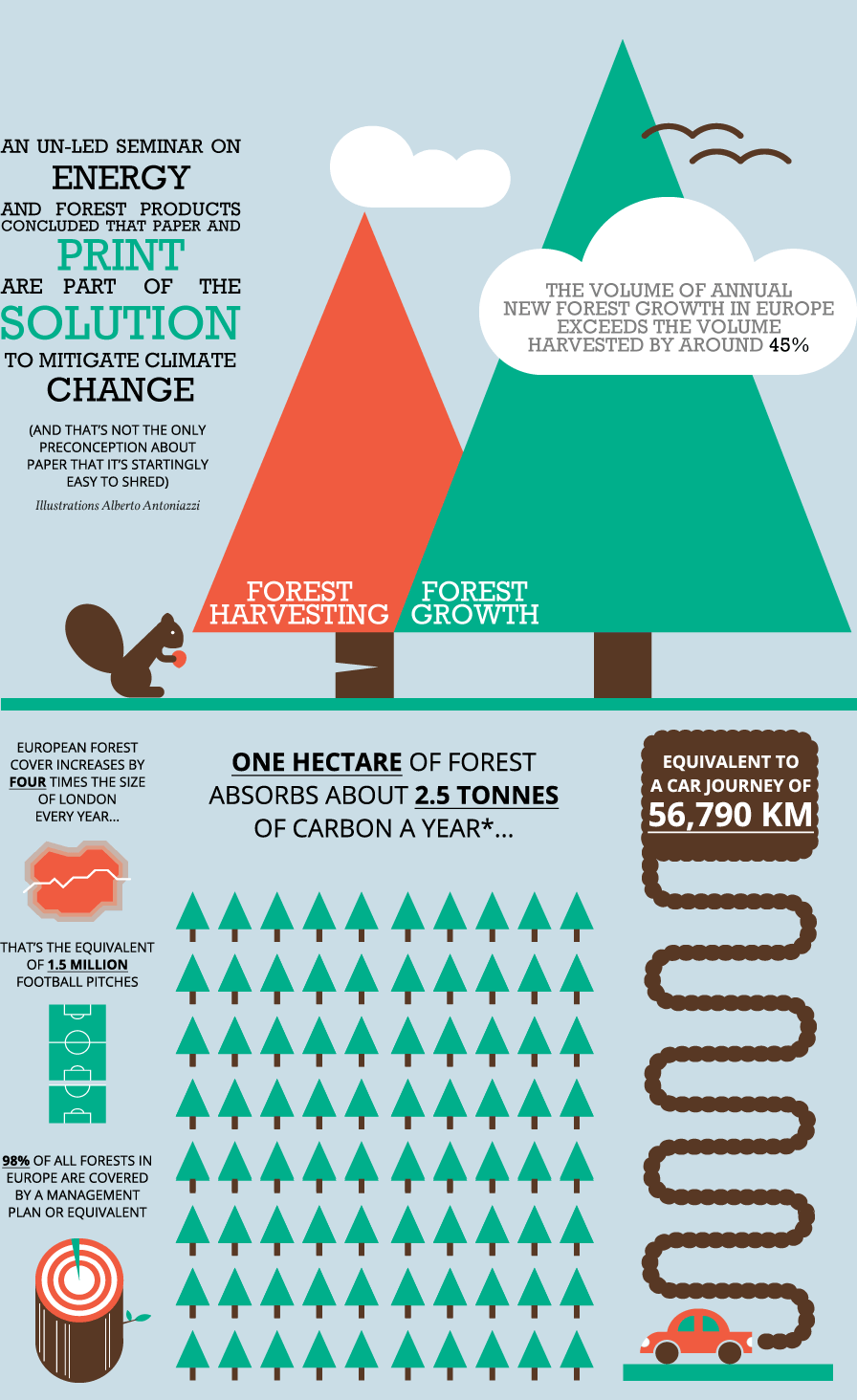 To coincide with INESAD’s November Environmental Sustainability month, today’s Monday Graphics series is making a case for the worth of stable ecosystems.
Assessing Forest Growth and Air Quality.
The first infographic based on a UN Seminar on Energy for Sustainable Development conducted in 2011, despite the increase in Europe’s paper production over the past 20 years, forest growth has exceeded the harvest of forest goods by 45 percent. This translates to an increase in air quality as un-harvested forests provide valuable ecosystem services such as carbon capture. Read More »
Does Biological Preservation Prevail Over Cultural Sustainability? The Struggle of the Maya Center Community in a Modernizing World
 With the highest concentration of jaguars in the world and an incredibly rich tropical biodiversity, the Cockscomb Basin Wildlife Sanctuary in Belize is an invaluable area not only for its scientific potential, but also due to the economic advantages of eco-tourism. Unfortunately, the installment of the wildlife sanctuary 25 years ago also meant that the inhabitants of Maya Center—a small Mopan Mayan village with a population of some 300 people located in the Stann Creek District in southern Belize—was subsequently prohibited from entering an area historically sacred to their culture. Does this mean that the new economic and scientific “necessities” prevail over the livelihoods and traditions of populations already living in the area?
In the early 1980’s, the Ministry of Natural Resources and the International Division of the New York Zoological Society began studying jaguar populations in the Cockscomb Basin after citrus farmers and hunting magazines reported sightings of jaguars in the area. Soon after the initial reports, scientific inquiries into the population of jaguars within the area resulted in the highest concentration ever recorded with estimates as high as 11 animals per 100 km². With eastern Belize dominated largely by a few wealthy citrus farmers, the establishment of a reserve was seen as a vital step to impeding and preserving the land from the increasing deforestation spawned by the citrus industry. More commonly known today as the Jaguar Reserve, the original 3,600 acres set aside in 1987 has expanded to encompass over 128,000 acres. Read More »