November 19, 2012
Alternatives, Climate Change, Conservation, Environmental Education, Infographics, Oil and Gas, Policy, Think Tanks
 To coincide with INESAD’s November Environmental Sustainability month, today’s Monday Graphics series is investigating pollution and sustainable innovations in Latin America.
The first infographic, entitled Pollution in Latin America, was compiled by Hispanically Speaking News using reports from the Economist Intelligence Unit, Yale and Columbia University, the World Health Organization (WHO), the World Bank and the Pan American Health Organization (PAHO), to show how pollution is affecting Latin America. In addition to illustrating the health hazards of pollution, such as the two million deaths a year attributed to it, countries like Nicaragua and Costa Rica are exemplified as countries heading towards environmental improvement. In fact, along with ranking fifth globally for its positive treatment of the environment, Costa Rica ranks first in a recent Happy Planet Index released by the New Economics Foundation, which measures how happy people are in relation to their ecological footprint. Read More »
November 15, 2012
Development, Food & Agriculture, Policy, Research, Rural Development, Think Tanks, Urban Development

Since entering the world of economics a short while ago I have repeatedly been surprised by some major development institutions’ lack of regard for the country-side and rural activities. In the 2009 the World Development Report the World Bank called on an increase in urbanization, and therefore a reduction in rural employment, as “essential for economic success.” This development policy was adopted by both the World Bank and a number of senior economists after seeing the positive effects that industrialization has had in North America, Western Europe and Northeastern Asia. One underlying view behind this popular urbanization theory is that the countryside is a breeding ground for poverty, which can only be relieved with mass migration to cities where “proper” economic activities in the service and business sectors can be undertaken.
Read More »
November 13, 2012
Capitalism, Culture, Ethics, Mining, Natural Resources, Oil and Gas, Policy, Sustainability
 Last night I tagged along to a dinner in Bangkok where I met a couple of executives of Thailand’s national energy company. Needless to say that, as someone with environmentalist proclivities, I was deeply interested in their ‘insider’ views of the industry, as I have learnt from experience that these can be revealing. Although, like taking a ring road bypass to dodge rush hour city traffic, all questions of the environmental impacts of such processes as fracking were skillfully avoided, several things struck me as the conversation turned to the company’s ambitions in the United States.
Fracking is a process of hydraulic fracturing that uses up to 300 tons of chemicals and injects large amounts of explosives and water to crack rock and release natural gases from deep wells. It presents an opportunity to get at previously untouchable gas and every oil and gas explorer wants a piece of the pie. However, according to the executives, the confidence with which the non-renewable industry operates is somewhat geographically determined. Read More »
November 12, 2012
Climate Change, Conservation, Ecosystem Services, Environmental Degradation, Environmental Economics, Environmental Education, Infographics, Natural Resources, Policy, Sustainability
 To coincide with INESAD’s November Environmental Sustainability month, today’s Monday Graphics series is making a case for the worth of stable ecosystems.
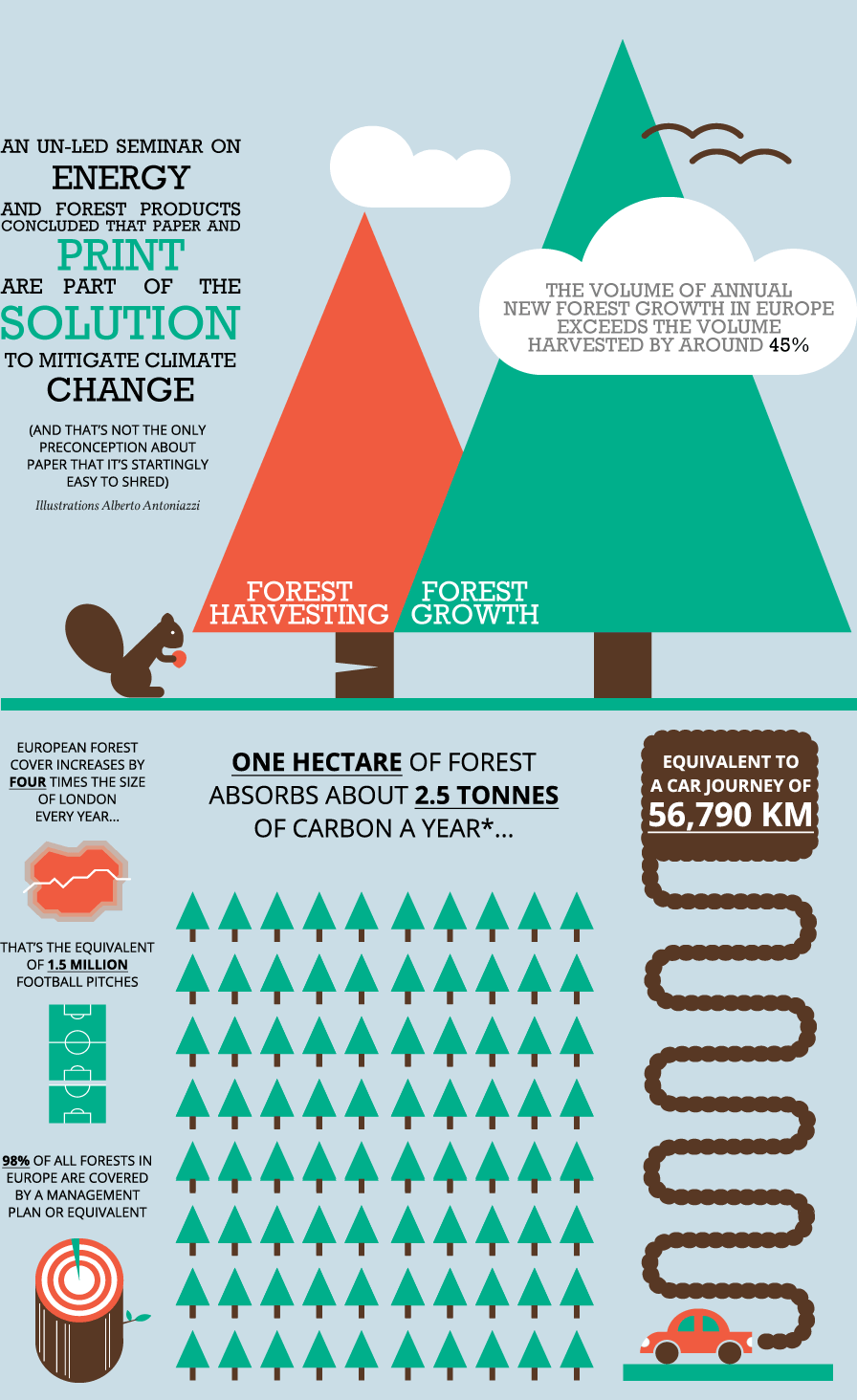
Assessing Forest Growth and Air Quality.
The first infographic based on a UN Seminar on Energy for Sustainable Development conducted in 2011, despite the increase in Europe’s paper production over the past 20 years, forest growth has exceeded the harvest of forest goods by 45 percent. This translates to an increase in air quality as un-harvested forests provide valuable ecosystem services such as carbon capture. Read More »
November 9, 2012
Agriculture, Capitalism, Development, Inequality, Inequality, International, Macroeconomics, Theory Bites, Trade
 The contemporary common language of development divides the world between developed and underdeveloped countries. This common-sensical classification also guides us to think of the two groups as rich and poor. Or even further, that the developed world, despite its imperfections, is “fine” and its people are happy—they represent the way human society should generally be—while the underdeveloped, for whichever reason, has just fallen behind—its people suffer and are not an example of what we’d like to see for humanity. The assumption is that everyone would prefer to live in a city, drive their car to work, and enjoy air conditioning and washing machines, since humans can and should “achieve” much more than washing their clothes by hand or farming for their own survival.
Read More »
November 9, 2012
Agriculture, Capitalism, Development, Food, Policy, Politics, Rural Development
 On the 16 October 2008 former President Clinton announced at a United Nations’ conference “we all blew it, even me.” This statement was acknowledging the major role that the west played in causing the 2006-2008 global food crisis, largely by their treatment of crops “like color TVs” rather than realizing their worth as a vital commodity for the world’s poor and thus differentiating them from material export/import goods.
Perhaps what is most surprising about this massive misjudgment of agricultural policies is that it was heavily promoted by a number of the institutions that we tend, or at least hope, to think are working for poverty eradication and not against it. Read More »
November 7, 2012
Environmental Economics, Guest Roast, Policy
 By Michael Jacobs
Over the past four years the concept of ‘green growth’ has burst onto the international policy scene. A term rarely heard before 2008, it now occupies a prominent position in the international policy discourse. The last two G20 Summits—international meetings of the heads of government of the largest 20 economies that began in response to the financial crash in 2008—declared their support for this goal. The World Bank, the Organisation for Economic Co-operation and Development (OECD) and the United Nations Environment Programme (UNEP) are all now committed to it. A new body, the Global Green Growth Institute, has been created to advise governments on its implementation. A whole panoply of green growth networks, forums and ‘knowledge platforms’ has sprung up.
Why? Read More »
November 2, 2012
Capitalism, Climate Change, Conservation, Consumerism, Development, Ecosystem Services, Environmental Degradation, Environmental Economics, Macroeconomics, Mining, Monetary, Natural Resources, Policy, Solutions, Statistics, Sustainability

“When the last tree is cut down, the last fish eaten, and the last stream poisoned, you will realize that you cannot eat money,” Native American saying
“Sustainable development is development that meets the needs of the present without compromising the ability of future generations to meet their own needs,” Brundtland Report
It is undeniable that our current way of life is unsustainable; If every country consumed resources and created waste at the same per person rate as the United States, we would need three to five planets to survive. Part of the problem lies in the fact that economics—the major discipline advising global and national policy—has failed to include the environment in its calculations. To rectify this problem, different methods have been proposed, so as to make predictions and come up with better ways of managing the planet’s resources without compromising the future.
Read More »
October 31, 2012
News, Policy
 Research, policy making and general life should be as fun as it is serious, so at INESAD we have let our hair down for an entertaining and productive month:
MEDIA FRENZY:
Having recently implemented a new media and communications strategy, during October INESAD began to reap the rewards. Ioulia Fenton, Adam Nelson and Carolynn Look published two articles as part of the cover story of the October issue Global South Development Magazine and October Development Roast articles by several INESAD staff have been re-posted to almost a dozen different news, research and policy sites, including:
Read More »
October 26, 2012
ICT for Development, Millenium Development Goals, Policy

Yesterday my grandfather turned 83. There he is in the picture below. The incredible half century gap between the before and after nostalgic snaps are shot next to his lifelong toy and companion: His Morse Code radio.
According the International Amateur Radio Union, more than two million amateur radio lovers just like my grandpa surf the radio waves in search of making connections with others all around the world. I am constantly reminded of the global popularity of this as a pastime when the conversation between us always and inevitably turns to his radio activities and latest certificates he gained. Read More »
 Development Roast Giving international development a proper roasting
 To coincide with INESAD’s November Environmental Sustainability month, today’s Monday Graphics series is investigating pollution and sustainable innovations in Latin America.