August 13, 2012
Agriculture, Education, Food, Food & Agriculture, Health, News, Obesity, Solutions
 Today, The Statesman in Austin, Texas, United States published a op-ed co-written by Danielle Nierenberg, Director at Worldwatch Institute‘s Nourishing the Planet (NtP) project and INESAD‘s Ioulia Fenton, who is spending the summer researching food and agriculture issues with NtP.
Helping Poor Children Avoid Poor Diets, The Statesman, Monday, August 13, 2012.
It’s almost time for kids to go back to school. But for many children in Austin, this means a return to terribly unhealthy school lunches fried chicken, pizza pockets, corn dogs, and desserts loaded with high-fructose corn syrup that jeopardize the health and well-being of America’s next generation. This needs to change. Read More »
August 1, 2012
Agriculture, Diet, Food, Food & Agriculture, Health, Obesity, Policy, Politics, Trade
 U.S. exports obesity epidemic to Mexico was the conclusion of a recent Institute for Agriculture and Trade Policy (IATP) report. The study looks at the health consequences of the North American Free Trade agreement (NAFTA), a tri-lateral trade liberalization agreement between Mexico, Canada, and the U.S. that came into effect in 1994. The researchers tracked the increases of U.S. exports into Mexico that followed NAFTA’s implementation. These included such items as soft drinks, snack foods, processed meats, and dairy, as well as raw inputs such as corn and soybeans that are used in the food processing industry. They then linked the rises to increased consumption of unhealthy foods and, thusly, to an incremental rise in the nation’s climbing obesity epidemic. Read More »
June 8, 2012
Agriculture, Rural Development, Urban Development
It is practically impossible to look into any part of international development without coming across “livelihood diversification”. It is a process whereby families in poor countries move away from relying on just one livelihood strategy to many different ones.
This is widely accepted to apply to the people of Asia, Africa and Latin America alike. The implication being that helping people diversify their livelihoods would be beneficial to development and poverty reduction, especially for those who cannot diversify themselves. Read More »
May 31, 2012
Agriculture, Alternatives, Ancient Technology, Food, Indigenous Peoples, Solutions, Sustainability, Water
“More and more and higher-level technology” is heralded as the way that the human population will eventually get itself out of the global troubles it has wreaked. Under-researched genetically modified seeds to be sold to poor rural farmers in India; financially, socially and environmentally expensive Three Dams Project in China; and ethically dubious biofuel alternatives made in order to stem the toxic air pollution of the global transport industry. Each high-tech solution has its merits and its downfalls, of course, but do we always need to be looking forward or could we learn something from our ancestors? Read More »
May 17, 2012
Agriculture, Conservation, Diet, Ethics, Food, Infographics, Natural Resources, Solutions, Water
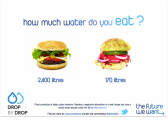 Meat production is thirsty business. Do you know much water do you eat? INESAD’s latest inforgraphic provides some real food for thought. Did you know, for example that a beef burger takes 2,400 litres of water to produce, compared to 170 litres for a vegetarian burger.
Find out more at www.unwater.org and www.waterfootprint.org.
Read More »
March 30, 2012
Agriculture, Diet, Food, Infographics, Water
 March 22nd saw this year’s World Water Day kick off a series of upcoming events organised by the UN and other organisations to highlight global water issues.
Luckily, there is lots of good news, like the fact that half of the internationally agreedMillennium Development Goal on safe drinking water and sanitation has been met ahead of schedule. According to a joint report by the World Health Organisation and UNICEF:
“Since 1990, more than 2 billion people have gained access to improved drinking water sources.” Read More »
March 21, 2012
Agriculture, Food, Food & Agriculture, Health, Obesity
 Corn, corn, corn; mountains of corn as far as the eye can see. The images of the piling up Iowa harvests were one of a number of poignant visuals brought forward by the 2007 documentary King Corn (available on Netflix). The fact is, US production of corn has been growing rapidly since the 1970s and this year American farmers will plant an unprecedented harvest – 94 million acres of corn crop. This is the largest since 1944 and will take up roughly a third of the country’s harvested cropland.
This expanse has been largely driven by a change in direction of US farm policy four decades ago. Previously, agricultural production was tightly controlled to ensure overproduction did not drive the prices that farmers could get for their harvests too low and helped ensure that available agricultural land was not overworked and the environment was not unduly harmed. Read More »
December 9, 2011
Agriculture, Book Roast, Food, Food & Agriculture, Policy, Politics
 In this 2010 book Robert Paarlberg takes a Q & A approach to a broad set of food and agriculture topics, covering aid and trade, obesity and famine, organic farming and genetically engineered (GE) organisms, and the food system’s effects on health and environment, among others. The work is a self-proclaimed attempt at “rebalancing some debates around food and farming” for “an aware audience of non-specialists.” And on the whole, its strength lies in its accessible style and the common myths it dispels: how buying local produce, for example, is not necessarily more environmentally friendly or the fact that global market food prices do not automatically increase local consumer costs.
For all its breadth, however, the book is beset by problems. Read More »
September 1, 2011
Agriculture, Policy, Rural Development, Urban Development
W hen it comes to development most take sides. I am not talking about of one country over another, or good guys versus the not so good guys. Theorists and practitioners, however, do like to specialise in either ‘rural’ or ‘urban’ development. However, the distinction between the two really isn’t quite so simple. National bench-marks of what is considered urban and what rural certainly don’t help either since, depending on which country’s definition you use, India can be more than 70% or less than 30% rural (1).
Take the city of Sololá, the capital of a municipality and a department of the same name in the highlands of Guatemala. Every municipal capital is considered ‘urban’ by the national statistics office and the city’s latest official population counted 68,120 people residing across four barrios (city sections) (2). Whilst this figure would ‘feel’ far too large to any visitor, warranting further investigation, the image of it built in the mind of a distant reader (and their subsequent analysis of it by students and policy makers alike) will vary greatly depending on which statistic is used by the author: the official city figure or the actual population residing within the ‘urban’ space, which, at 8,851 is barely 13% of that (3). And that isn’t the city’s only rural-urban misconception. Read More »
July 27, 2011
Agriculture, Food, Food & Agriculture, Girls & Women, Health
 As the Victoria Beckhams of this world have replaced the Marilyn Monroes on the centerfolds of magazines and advertisements selling everything from perfume to real estate, wide social effects have taken place in rich nations. Although size zeros are no heroes, adolescent girls and grown women the world over have succumb to chasing the promised good feel of the thinness ideal. At the extreme, this chase can lead to conditions diagnosed by mental health professionals as binge eating and disordered eating (which includes self-starvation, bingeing, purging and exercising obsessively), leading to more widely known conditions of anorexia (self starvation) and bulimia (regular self-induced cycles of binge-eating and vomiting), found to affect up to 5.7% and 7.3% of women in Western nations respectively (1). Both are addictive psychological attempts to take back control over inputs into the body and sometimes other aspects of life. And both are on the rise in less wealthy countries too as they transition into Western lifestyles brought to them through cultural and corporate marketing transmissions associated with the age of globalisation (2). Read More »
 Development Roast Giving international development a proper roasting