June 21, 2013
Agriculture, Climate Change, Environmental Education, Food, Food & Agriculture, Indigenous Peoples, Water
 Today, the time of the Winter Solstice in the Southern hemisphere, marks the beginning of the new agricultural year for the Aymara indigenous people of the Andean region. In June 2010, Bolivia’s President Evo Morales, an Aymara himself, decreed June 21 as an important national holiday: the Aymara New Year.
Although the celebrations center in the ancient ruins of Tiwanaku, with more than 50,000 participants in 2010, all over Bolivia, indigenous Aymarans gather on this typically coldest, longest night of the year to see in the sunrise. They brave the freezing temperatures in order to welcome the sun out of its winter season, characterized by short days and early darkness, and into longer days and more sunshine. Rituals back-dropped with traditional music abound and sacrifices of llama, incense, alcohol, and coca are offered to Pachamama (mother nature/Mother Earth) until sunrise. All of this is in the hopes of enticing Tata Inti, the sun god, to heal the earth and give the farmers a good harvest. Read More »
June 1, 2013
Bolivia Climate Change Monthly, Climate Change
 Welcome to the May 2013 issue of Bolivia Climate Change Monthly where you will find the latest research, policy and news related to climate change in Bolivia*.

Carbon stocks and dynamics in grazing highlands from the Andean Plateau by M.A. Munoz, A. Faz, and R. Zornova published in CATENA.
Elevational Distribution and Conservation Biogeography of Phanaeine Dung Beetles (Coleoptera: Scarabaeinae) in Bolivia by S. K. Herzog, A. C. Hamel-Leigue, T. H. Larsen, D. J. Mann, R. W. Soria-Auza, B. D. Gill, W. D. Edmonds, and S. Spector published in open access journal PLoS ONE.
A land cover map of Latin America and the Caribbean in the framework of the SERENA project, by P. D. Banco et al, published in Remote Sensing of Environment.
The development of soil and water conservation policies and practices in five selected countries from 1960 to 2010 by J. de Graaffa, A. Aklilub, M. Ouessarc, S. Asins-Velisd, and A. Kesslera published in Land Use Policy.
Read More »
May 9, 2013
Carbon sequestration, Climate Change, Ecosystem Services, Environmental Degradation, Natural Resources, Policy, Solutions, Sustainability
 Efforts to thoroughly study the role that plants play in climate change mitigation are increasing. Most researchers focus on the promise of large, leafy forest trees to help remove carbon from the atmosphere; for example Lal (1998) in India, Chen (1999) in Canada, Zhang (2003) in China, and Monson ( 2002) in the United States. This is because, generally speaking, the bigger the plant, the more CO2 it absorbs – click here to see how plants do this – and trees are the most obvious large plant species. However, there are some very large non-tree plants in the world and increasing evidence points to a surprising grassy climate change warrior: bamboo.
One species of bamboo, the guadua angustifolia, found in Venezuela, Ecuador, and Colombia, has been shown to grow up to 25 meters in height and 22 centimeters in diameter, with each plant weighing up to 100 kilograms (Rojas de Sánchez, 2004). This doesn’t match the stature of many trees, but it is still big enough to be significant. It is not all about size, however. How fast a plant grows has a part in determining how much CO2 it can absorb in a given time. In this respect, bamboo wins hands-down: it grows faster than many trees, growing up to 1.2 meters per day. In fact, bamboo holds the Guinness World Record for the world’s fastest growing plant. Read More »
May 9, 2013
Carbon sequestration, Climate Change, Ecosystem Services, Environmental Degradation, Natural Resources, Sustainability
Much is written about the need to reduce deforestation and replant the forests that have been logged for human use and economic development. This is because trees are needed for fighting climate change and vital to the very survival of the planet. But what is it exactly that makes trees and other plants so special?
Climate change is caused, at least partly, by man-made emissions of greenhouse gases which accumulate in the Earth’s atmosphere and trap heat. The Intergovernmental Panel on Climate Change (IPCC), set up in 1988 by the United Nations Environment Programme (UNEP) and the World Meteorological Organization (WMO), and endorsed by the General Assembly of the United Nations, is the leading international body for assessing this phenomenon.
In their most recent Assessment Report from 2007, the IPCC reported that carbon dioxide (CO2) is the most significant anthropogenic greenhouse gas, both in the sense of the amount of heat it traps and the quantity that is released into the atmosphere (mainly from the burning of fossil fuels). Forests are very effective ‘carbon sinks’, extracting CO2 from the atmosphere and keeping it locked away for long periods of time. Therefore, some of the key strategies to alleviate the causes and effects of climate change recommended by the IPCC include efforts to reduce deforestation, while simultaneously increasing afforestation and reforestation: planting of forests where none were before and replanting areas where forest has been removed, respectively. Read More »
March 6, 2013
Climate Change, Infographics
 Does climate change exist and are humans to blame is a question that still manages to liven up many a dinner conversation. Believers can be short on facts and figures to be quoted in the face of deniers who tend to distrust the science, the politicians, and the activists. Luckily, Mother Jones has a secret weapon: A light-hearted flowchart that can be used as a handy cheat sheet to help put the matter to rest: Read More »
March 1, 2013
Agriculture, Food, Oil and Gas, Solutions, Sustainability
The Earth’s climate is changing and the vast majority of the scientific community as well as the public is now convinced that human activity is contributing significantly to this phenomenon. The underlying cause is an increase in the concentration of ‘greenhouse gases’ in the Earth’s atmosphere, such as carbon dioxide, which is released when fossil fuels are burnt; nitrous oxide from chemical fertilizers; and methane which is produced from activities like rice farming and livestock production. These gases trap heat in the atmosphere, leading to the ‘greenhouse effect’ – a rise in the average global temperature which leads to melting ice-caps and therefore rising sea-levels. Additionally, the change in the atmosphere makes the climate more unpredictable, increasing the incidence of ‘freak’ weather events such as hurricanes, floods and droughts (‘global weirding’). Regardless of what is causing the climate to change, preparations need to be made to cope with the consequences as they will impact on many aspects of life. One of these will be the world’s food supplies and food prices, since agricultural growing conditions will change in certain places, affecting the type and quantity of crops that can be grown. This in turn will affect people’s ability to buy and otherwise access food.
However, right now, the biggest impact of climate change on food supplies and food access does not come directly from the changes in climate. Instead, it comes from one of the ways in which we are trying to stop climate change: biofuels. ‘Undercovering Undernutrition Part II‘ showed that the growing demand for biofuels (mainly from western countries) means that in some areas biofuel crops are being grown preferentially over food crops due to their profitability. A 2010 report by the Institute for European Environmental Policy (IEEP) reported that European countries have chosen to meet the European Union (EU) legal requirement of including 10 percent of renewable energy in all transport fuels by 2020 by importing biofuels from places such as Indonesia, Brazil, and some African countries. One of the results, reported by The Guardian newspaper, is that the land acquired over the past decade for growing biofuel crops could have produced food for a billion people. This has led to increased food prices, leading to more people being unable to afford food and therefore going hungry. Read More »
February 27, 2013
Agriculture, Ancient Technology, Food, Solutions, Sustainability
In 1957 the remains of a civilization from 3,000 years ago were discovered in El Beni, a lowland region in the northeast of Bolivia (see map below). This civilization was found to have a highly productive agricultural system which involved the construction of camellones (ridges). These were elevated fields, built to be above the height of the floodwaters, surrounded by channels. This produced a method of irrigation that protected crops from flooding whilst increasing the fertility of the soil. In the wet season, the rainwater collected in the channels, preventing the crops from being washed away. The water could then be stored and used to water crops in times of drought. This system was designed specifically for the ecosystem of the region which is particularly prone to flooding. Read More »
November 19, 2012
Alternatives, Climate Change, Conservation, Environmental Education, Infographics, Oil and Gas, Policy, Think Tanks
 To coincide with INESAD’s November Environmental Sustainability month, today’s Monday Graphics series is investigating pollution and sustainable innovations in Latin America.
The first infographic, entitled Pollution in Latin America, was compiled by Hispanically Speaking News using reports from the Economist Intelligence Unit, Yale and Columbia University, the World Health Organization (WHO), the World Bank and the Pan American Health Organization (PAHO), to show how pollution is affecting Latin America. In addition to illustrating the health hazards of pollution, such as the two million deaths a year attributed to it, countries like Nicaragua and Costa Rica are exemplified as countries heading towards environmental improvement. In fact, along with ranking fifth globally for its positive treatment of the environment, Costa Rica ranks first in a recent Happy Planet Index released by the New Economics Foundation, which measures how happy people are in relation to their ecological footprint. Read More »
November 12, 2012
Climate Change, Conservation, Ecosystem Services, Environmental Degradation, Environmental Economics, Environmental Education, Infographics, Natural Resources, Policy, Sustainability
 To coincide with INESAD’s November Environmental Sustainability month, today’s Monday Graphics series is making a case for the worth of stable ecosystems.
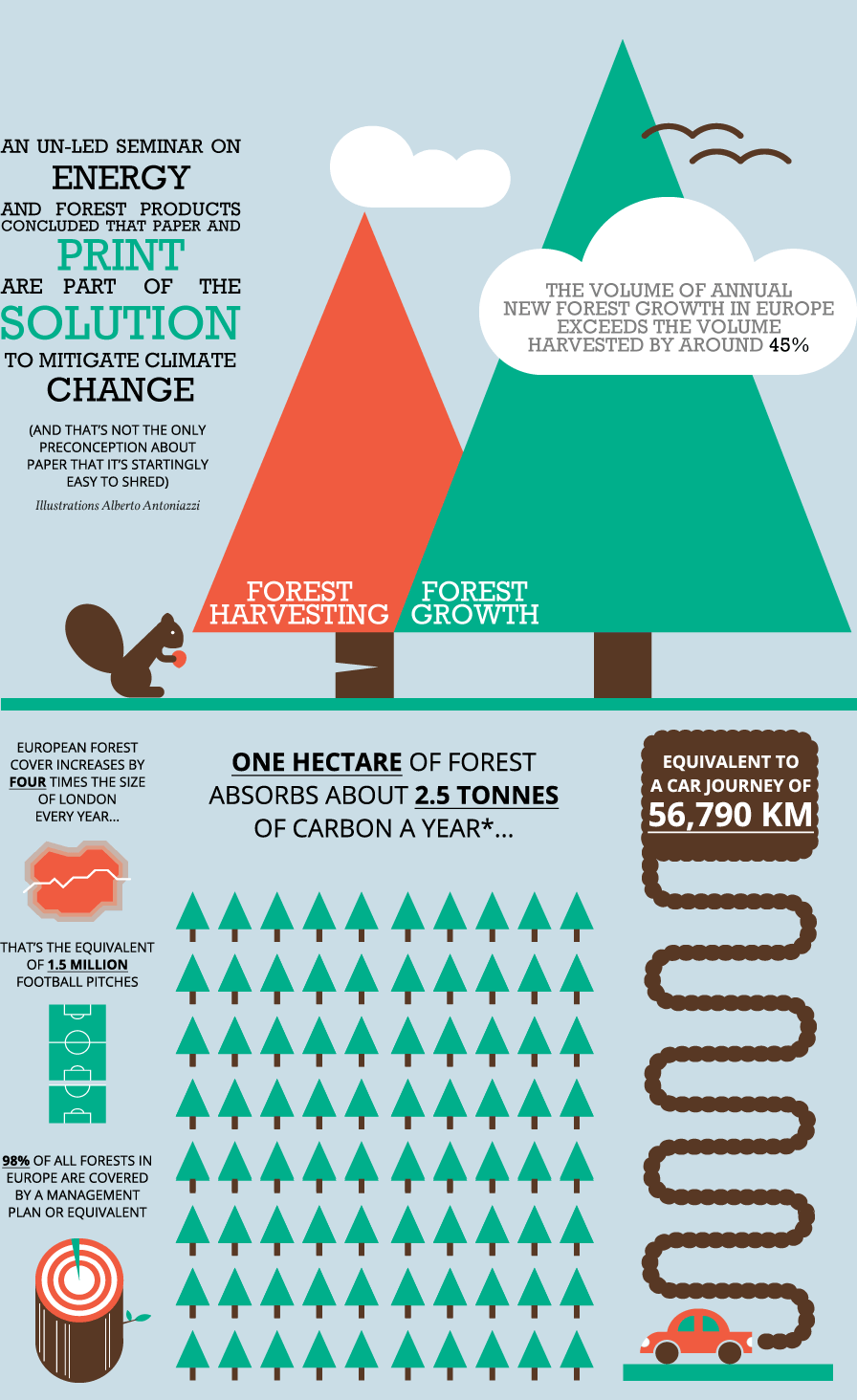
Assessing Forest Growth and Air Quality.
The first infographic based on a UN Seminar on Energy for Sustainable Development conducted in 2011, despite the increase in Europe’s paper production over the past 20 years, forest growth has exceeded the harvest of forest goods by 45 percent. This translates to an increase in air quality as un-harvested forests provide valuable ecosystem services such as carbon capture. Read More »
November 5, 2012
Climate Change, Environmental Economics, Fun, Infographics
 Over the next four weeks, to coincide with INESAD’s Environmental Sustainability Month, Development Roast will release fascinating and informative infographic every Monday. To kick off the month, we bring you those depicting one of the most pressing environmental issues to date, global warming.
Read More »
 Development Roast Giving international development a proper roasting