May 7, 2013
Agriculture, Macroeconomics, Mining, Natural Resources, Oil and Gas, Trade
 HAZ CLIC AQUÍ para leer en español.
China’s strong growth has been extensively reported and debated due to its significant impacts on the prices and volumes of commercial flows during the last few decades. The economic behavior of China is fundamental given that it has one of the highest Gross Domestic Products (GDP) in the world (second only to the United States) and that it has a population that makes up approximately 15 percent of the world’s total.
The 2012 ECLAC document ‘Panorama of the International Insertion of Latin America and the Caribbean’ contains information that allows an analysis of China’s influence on international commerce to be performed. The data are presented in the following table. Read More »
May 2, 2013
Climate Change, Conservation, Environmental Economics, Natural Resources, News, Policy, Solutions
 One of INESAD’s specialties is to work together with the Bolivian Government and donors to facilitate the design of effective, efficient, and equitable development policies and projects in Bolivia. We are pleased to announce the latest example of this.
INESAD is currently partnering with the Danish Embassy to help them work with the government to formulate the Program for Integral and Sustainable Management of Forests and Energy in Bolivia for the period 2014-2018. This Program supports the Joint Mechanism of Mitigation and Adaptation for the Integral and Sustainable Management of Forests and Mother Earth with about US $26 million. It will also support the development of renewable energy sources in order to reduce the use of highly subsidized and contaminating diesel for the generation of energy in northern Bolivia. Read More »
December 1, 2012
Agriculture, Capitalism, Environmental Degradation, Food, Food & Agriculture, Inequality, Natural Resources, Policy, Rural Development
 Over the last two decades there has been a great surge in land reform policies in developing countries. These land reform policies have mainly focused on rural property rights, and have consisted of giving small to medium size farmers, who for years have suffered from tenure insecurity, legal ownership of their land and property. Land reform has different objectives in different countries, but it is generally an attempt to boost development of the agricultural sector and rural regions, where poverty is often at its most extreme. It is also used to appease peasant farmers, who in many countries are increasingly disgruntled by the rural inequality legacy of colonialism that is now being heightened by the rise of wealthy large scale agribusinesses due to the globalization of the food market.
Read More »
November 30, 2012
Climate Change, Conservation, Ecocide, Environmental Degradation, Indigenous Peoples, Natural Resources, Solutions, Sustainability
 Today there are 8 billion human beings, speaking around 7000 different languages, sharing the Earth with 8 millions different species of plants and animals. This is the amazing diversity of life on our planet, which is sadly under threat from deeds of large-scale environmental damage. Some are calling these ‘acts of ecocide’ and fighting for them to be punishable by international criminal law.
The word ‘ecocide’ is derived from the Greek oikos (dwelling place, habitation) and the Latin -cida (one who kills). A legal definition, proposed by international barrister Polly Higgins in her campaign Eradicating Ecocide is “the extensive damage to, destruction of or loss of ecosystem(s) of a given territory, whether by human agency or by other causes, to such an extent that peaceful enjoyment by the inhabitants of that territory has been or will be severely diminished.” Read More »
November 23, 2012
Guest Roast, Natural Resources, Policy, Sustainability
 By: Miguel Rodríguez Tejerina
Despite half of Bolivia being covered by forest, the forest sector represents only 1-2% of GDP. According to Supreme Decree 26075 of 2001, more than 40 million hectares are destined by the State for sustainable forest use, but currently only about 9 million hectares are being sustainably managed for wood production, mostly by private companies (5 million hectares) and indigenous and peasant communities. The rest is either not being used, or being exploited in an illegal and haphazard manner.
Read More »
November 13, 2012
Capitalism, Culture, Ethics, Mining, Natural Resources, Oil and Gas, Policy, Sustainability
 Last night I tagged along to a dinner in Bangkok where I met a couple of executives of Thailand’s national energy company. Needless to say that, as someone with environmentalist proclivities, I was deeply interested in their ‘insider’ views of the industry, as I have learnt from experience that these can be revealing. Although, like taking a ring road bypass to dodge rush hour city traffic, all questions of the environmental impacts of such processes as fracking were skillfully avoided, several things struck me as the conversation turned to the company’s ambitions in the United States.
Fracking is a process of hydraulic fracturing that uses up to 300 tons of chemicals and injects large amounts of explosives and water to crack rock and release natural gases from deep wells. It presents an opportunity to get at previously untouchable gas and every oil and gas explorer wants a piece of the pie. However, according to the executives, the confidence with which the non-renewable industry operates is somewhat geographically determined. Read More »
November 12, 2012
Climate Change, Conservation, Ecosystem Services, Environmental Degradation, Environmental Economics, Environmental Education, Infographics, Natural Resources, Policy, Sustainability
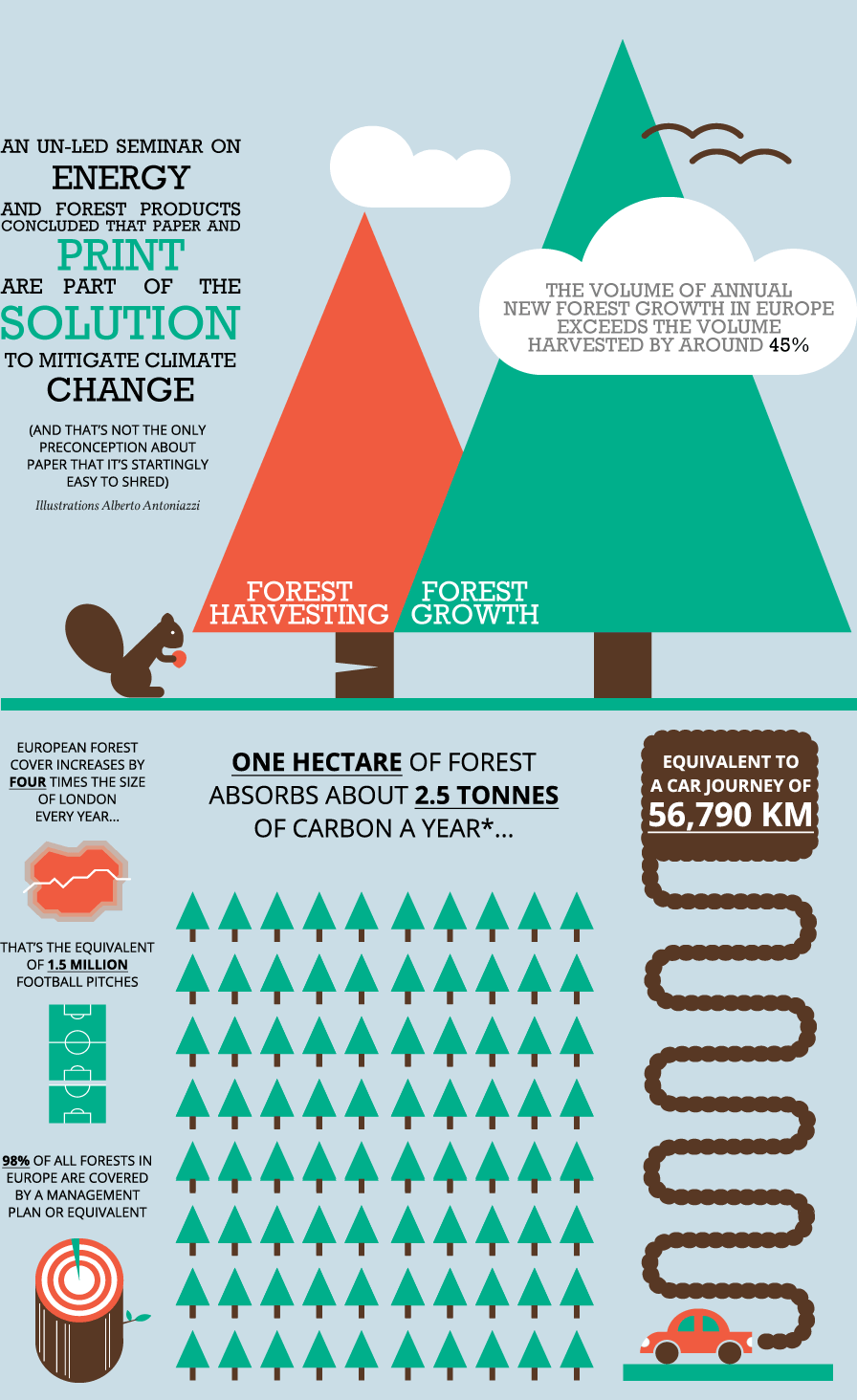
 To coincide with INESAD’s November Environmental Sustainability month, today’s Monday Graphics series is making a case for the worth of stable ecosystems.
Assessing Forest Growth and Air Quality.
The first infographic based on a UN Seminar on Energy for Sustainable Development conducted in 2011, despite the increase in Europe’s paper production over the past 20 years, forest growth has exceeded the harvest of forest goods by 45 percent. This translates to an increase in air quality as un-harvested forests provide valuable ecosystem services such as carbon capture. Read More »
November 6, 2012
Ecosystem Services, Environmental Economics, Natural Resources, Sustainability
According to Conservation International‘s 2009 book, The Wealth of Nature, ecosystems support and regulate all natural processes on earth, while contributing to cultural, social, and economic benefits to human communities. These have become known as ecosystem services and, according to the Rainforest Conservation Fund (RCF), they would cost trillions of dollars per year if human beings had to provide them for themselves. Here are just five types of many of the ecosystem services provided to people and planet by the world’s rainforests: Read More »
November 2, 2012
Capitalism, Climate Change, Conservation, Consumerism, Development, Ecosystem Services, Environmental Degradation, Environmental Economics, Macroeconomics, Mining, Monetary, Natural Resources, Policy, Solutions, Statistics, Sustainability

“When the last tree is cut down, the last fish eaten, and the last stream poisoned, you will realize that you cannot eat money,” Native American saying
“Sustainable development is development that meets the needs of the present without compromising the ability of future generations to meet their own needs,” Brundtland Report
It is undeniable that our current way of life is unsustainable; If every country consumed resources and created waste at the same per person rate as the United States, we would need three to five planets to survive. Part of the problem lies in the fact that economics—the major discipline advising global and national policy—has failed to include the environment in its calculations. To rectify this problem, different methods have been proposed, so as to make predictions and come up with better ways of managing the planet’s resources without compromising the future.
Read More »
November 1, 2012
Ecosystem Services, Environmental Economics, Food & Agriculture, Guest Roast, Natural Resources, Solutions
By Tim Gieseke
“Give me a lever long enough and a place to stand, and I will move the world.” Archimedes, 230 BC
Nothing seems to loom larger than the degradation of the environment at the hand of the growing global economy. This antagonistic relationship has been recognized for centuries and was made famous by Garrett Hardin’s 1967 essay of the “Tragedy of the Commons”. Read More »
 Development Roast Giving international development a proper roasting